Users Guide to JOBS IN JAPAN (Employers)

JOBS IN JAPAN Employer’s Manual

Following is a guide to help you use the JOBS IN JAPAN website and features more effectively and efficiently. If you have questions or need assistance in posting your job or using the site, please let us know at [email protected] as we are happy to help.

To access the Employers area click on the ‘Employers’ link located in the top-right corner of the JOBS IN JAPAN homepage. (If you’re a first-time user, click the ‘Register’ tab).

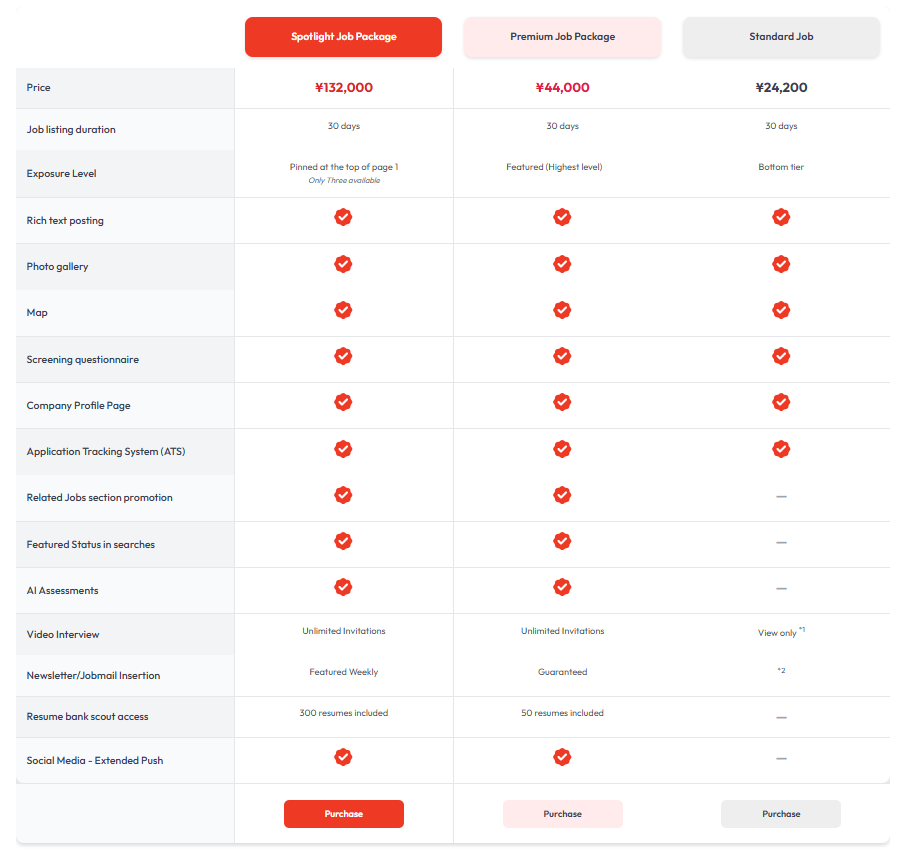
Select the posting package which best meets your needs and budget.


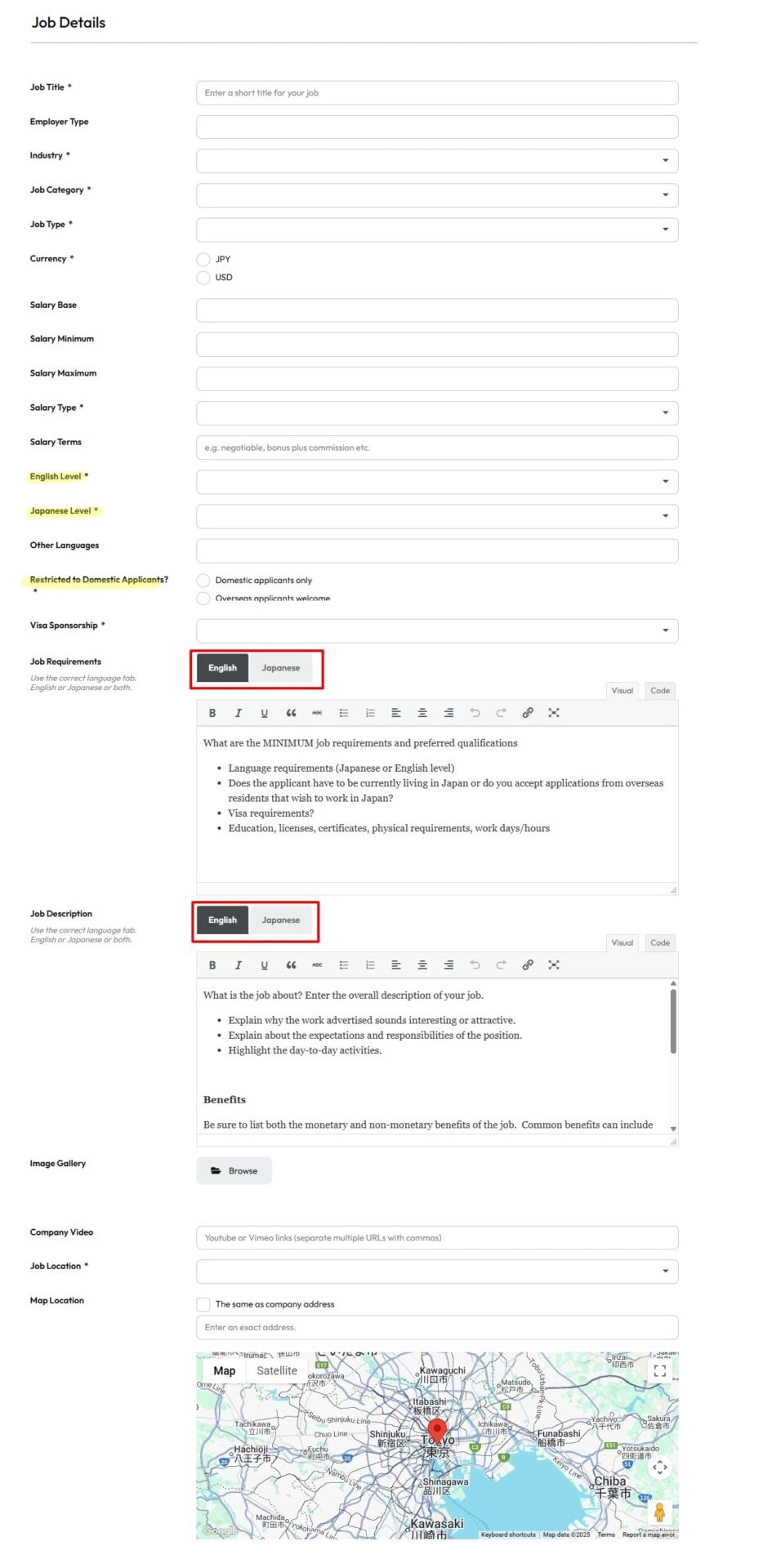
Job Description – If you need tips on writing an effective job description, please see our notes here


Salary Minimum/Maximum – If the position has a large pay range, it is helpful to explain in the job description area the criteria for the difference in pay.


Hard Filters – For the English / Japanese Language ability and “Restricted to Domestic Applicants” requirements, job seekers that do not match or exceed these criteria will be blocked from applying to you position.


Requirements and Job description section (English / Japanese) – English is the default language for the site.  If you want to have Japanese added, please do so.  If you leave the Japanese blank, the English will be copied over and the Japanese will be machine translated.


Image Gallery – Job descriptions with images gather more applications than those without. Images that work well are those of the interior of the company and those of staff working at the company.


Video – If you do not have a corporate video, many companies (especially rural ones) insert a travel/tourist information YouTube video to give the job seeker an idea of what it is like to live in that city.   Some companies have found it useful to have the Hiring Manager or Executive record himself/herself giving a short video message about the company and position.

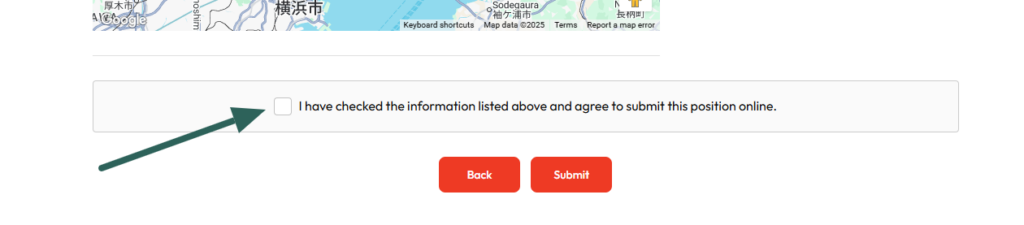
After creating your job description, a preview of the job will be displayed to show you how the job will look online. Please check the approval box and submit tab at the bottom of this page to publish your job online or it will remain in the “DRAFT” stage.

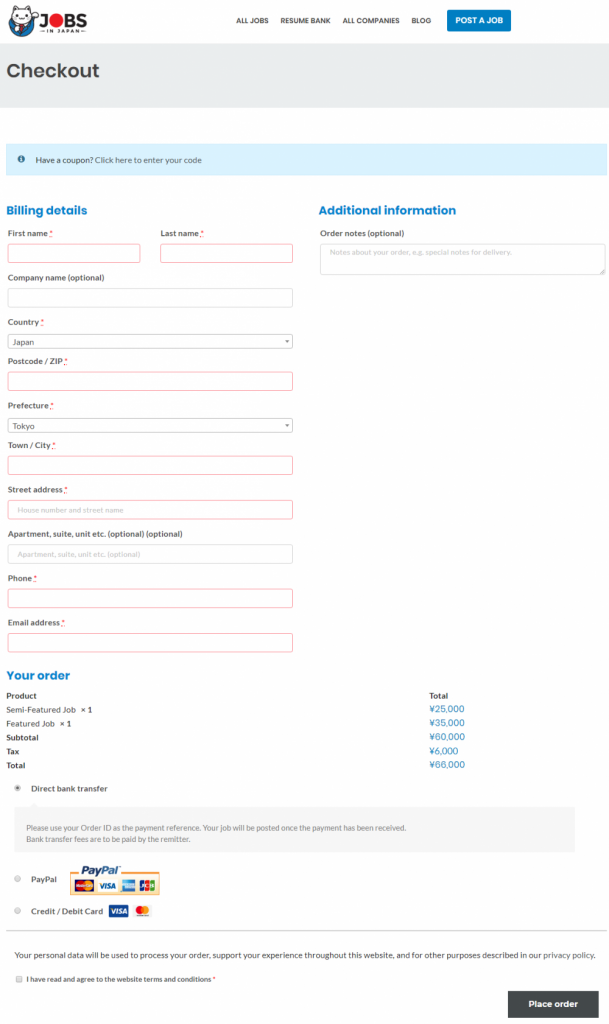
JobsinJapan.com accepts payment via Bank Transfer, Credit Card (Visa or MasterCard) or PayPal.

Note: In principle, Employers are expected to make pre-payment for job listings. As there is a time delay when confirming payments made by bank transfer, it is advisable to use an electronic payment method if listing the position is urgent.

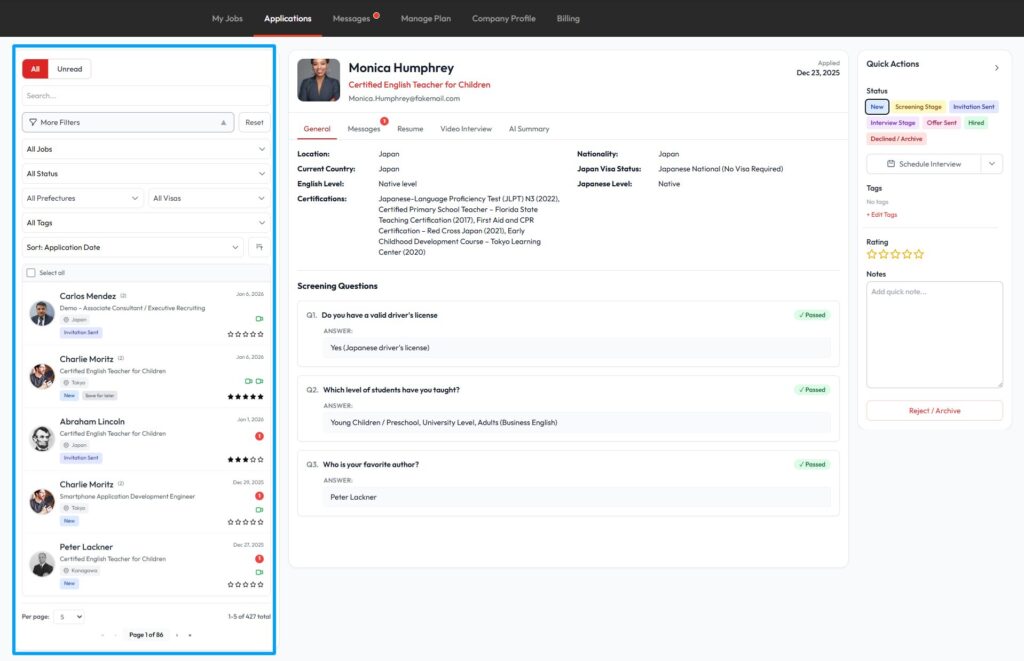
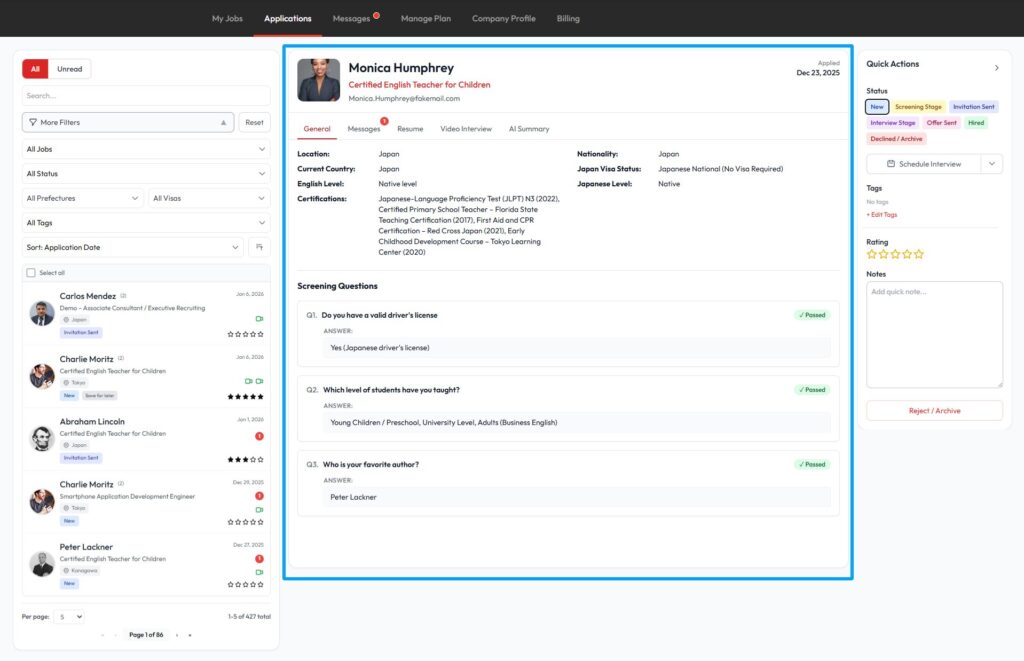
The Manage Applicants page will have an inbox with all your applicants along with features to help you sort, rank and communicate with the job seekers who have applied to your positions.

a) Left Column Inbox – one can search or sort applicants by criteria such as: job applied to, profile information (prefecture, visa), tag, stars, status, and application/message.

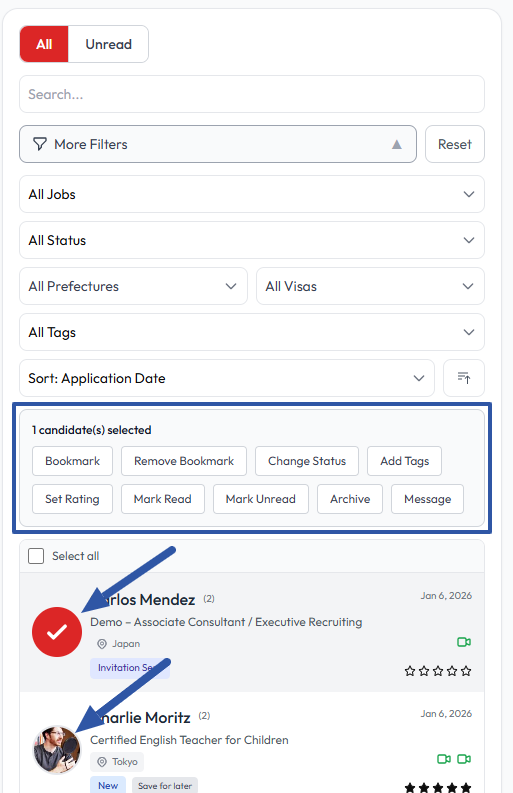
Bulk Features – Clicking on the applicant’s profile photo will select the applicants allowing for you to make bulk changes or updates.

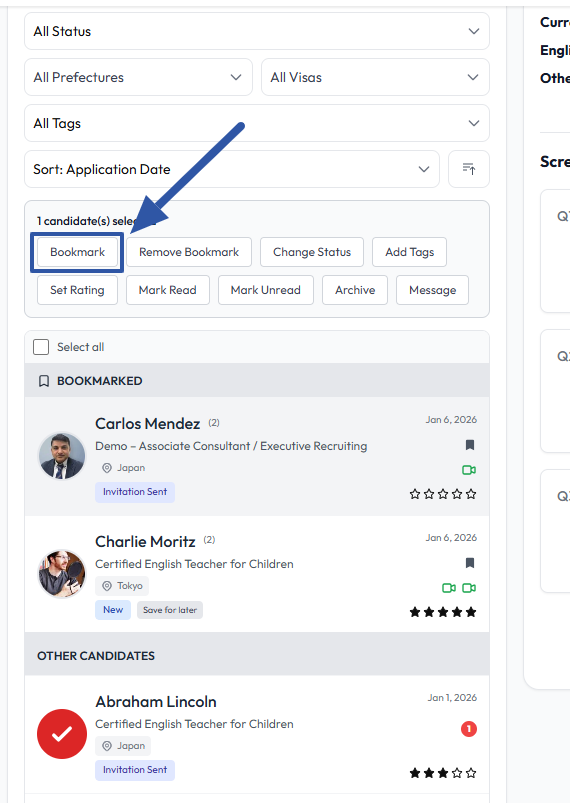
Bookmark – Using the Bookmark feature will make a special section at the top of the listings for these special applicants.

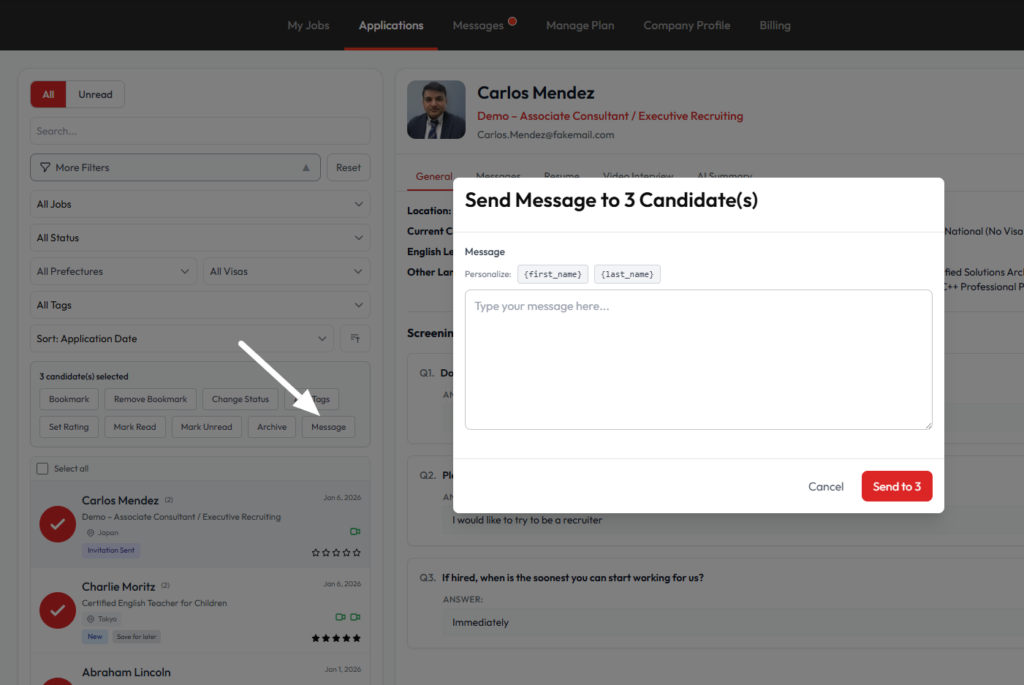
Bulk Messages – Bulk messages can also be personalized making the recipient feel more valued: “Dear [Name], thank you for your interest…”

General Tab

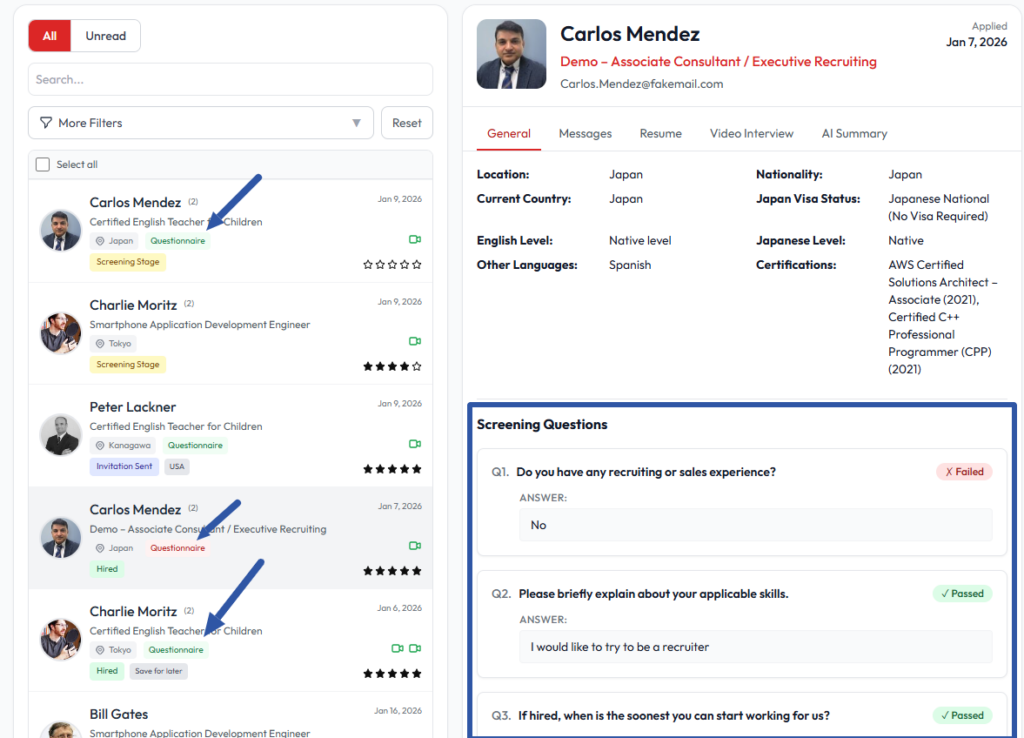
Profile information and response to the Application Screening Questionnaire (if used).

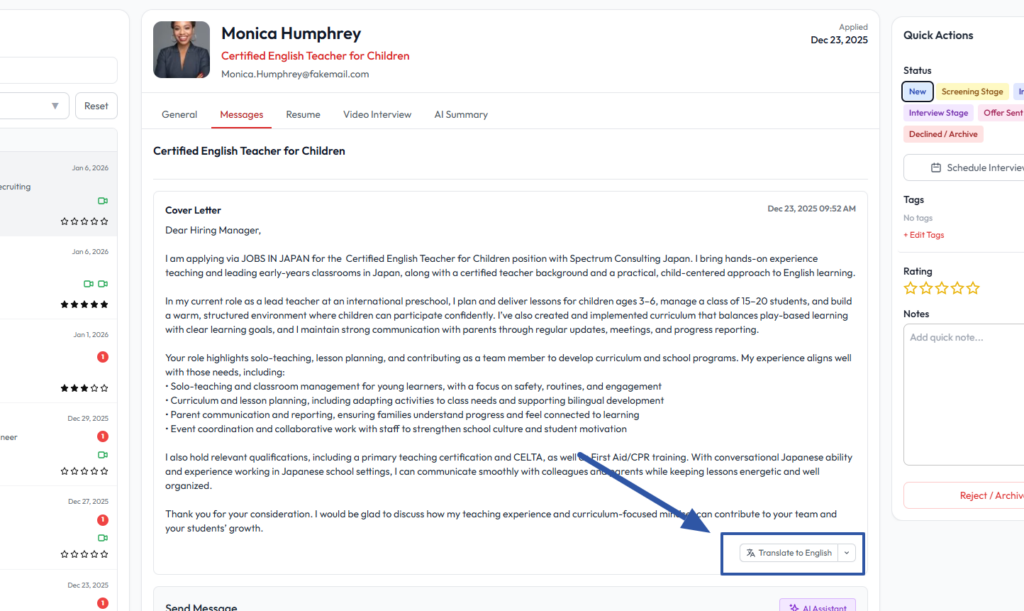
Messages tab (cover letter + communication)

The Messages tab contains the cover letter and your full message history with the applicant.
As  messages aren’t always in your native language—for example, a Japanese hiring manager reviewing English applications—we include a translation tool to help you review content more easily.

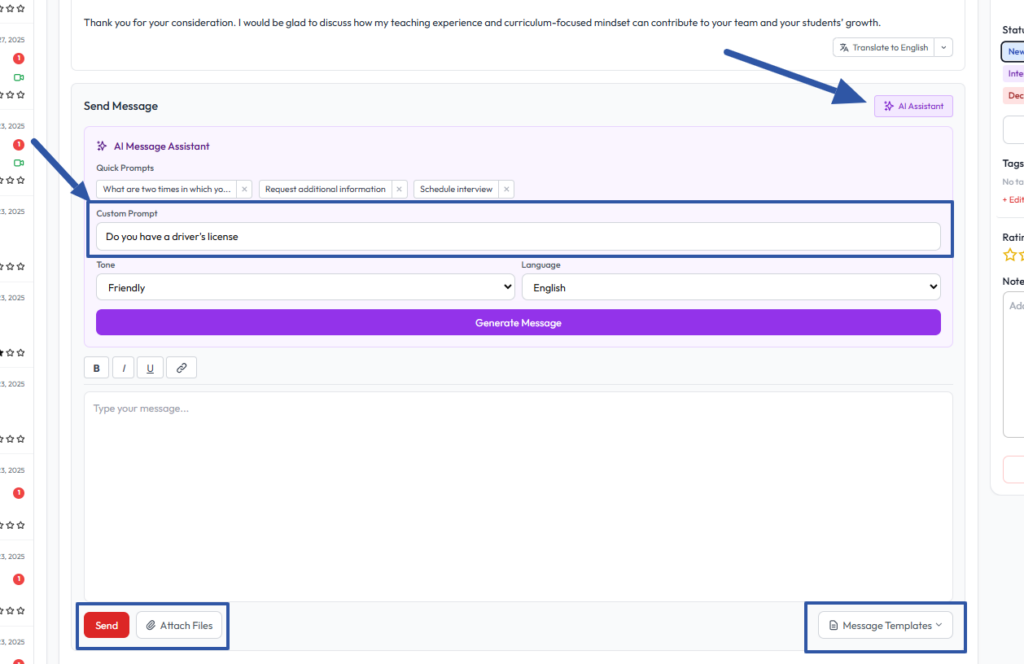
AI Assistant

When you’re ready to respond, the AI Assistant can help you draft a message from a single prompt. You can write in any language (English, Japanese, misspelled with just keywords, etc.), and you can set the tone—polite, friendly, direct, or formal.
For example, you could prompt:

  • “Ask for two or three available times next week.”
  • “Confirm whether they have a valid driver’s license.”
  • “Send a short thank-you message.”

The result is personalized and doesn’t read like a generic form letter.

If you like the draft, you can save it as a template for future use.
The rest works like a standard email system where you can also attach files when needed.

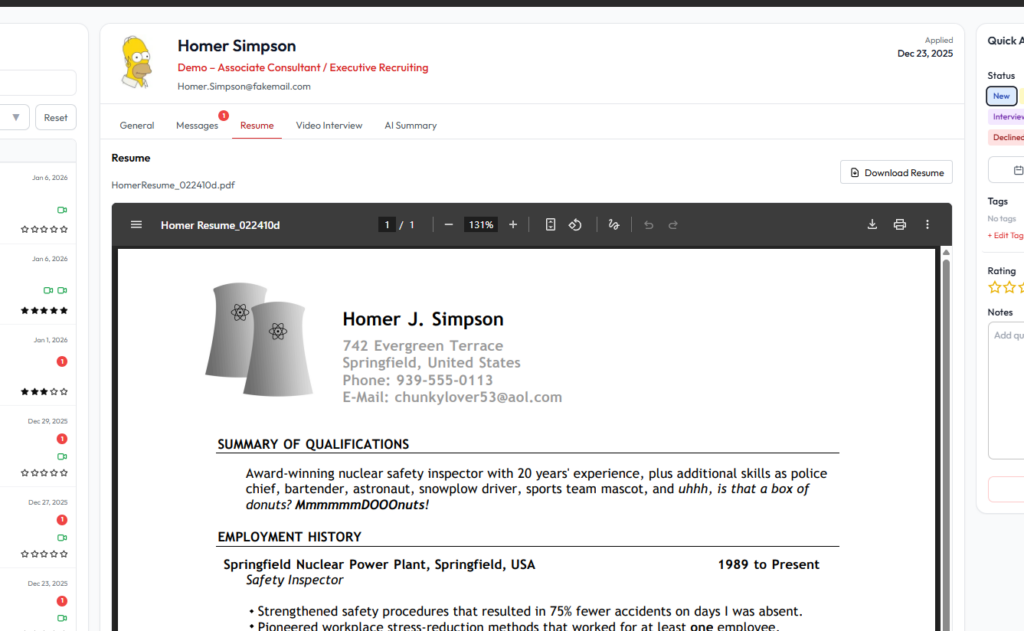
The Resume tab includes the applicant’s resume, as well as any attachments you requested.

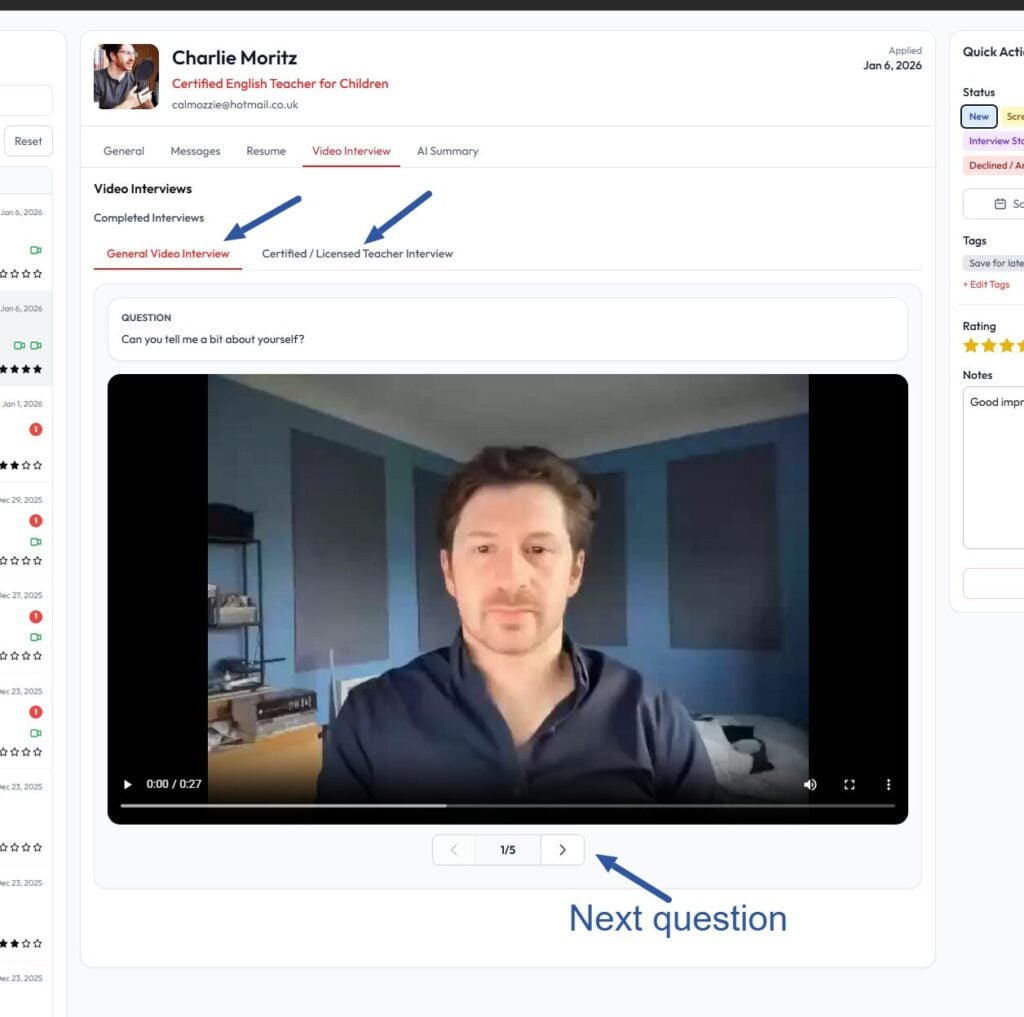
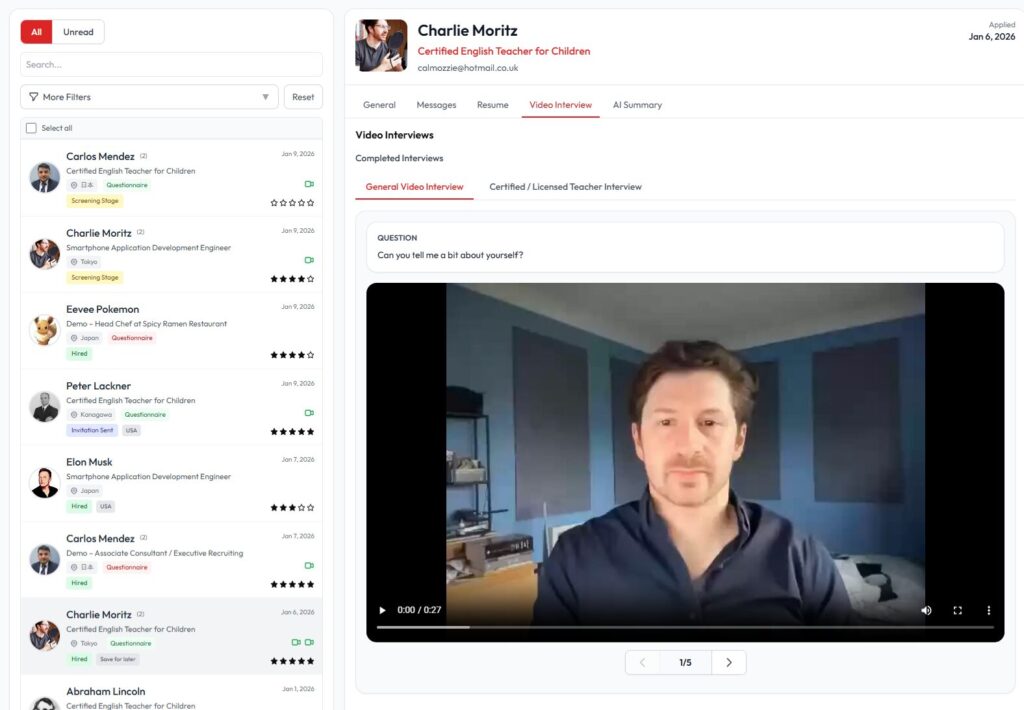
The Video Interview tab shows the applicant’s pre-recorded interview responses.
You can watch the videos, review answers to standard interview questions, and move faster through initial screening.

This candidate has take two of our standard video interviews.  Navigation tabs at the bottom.

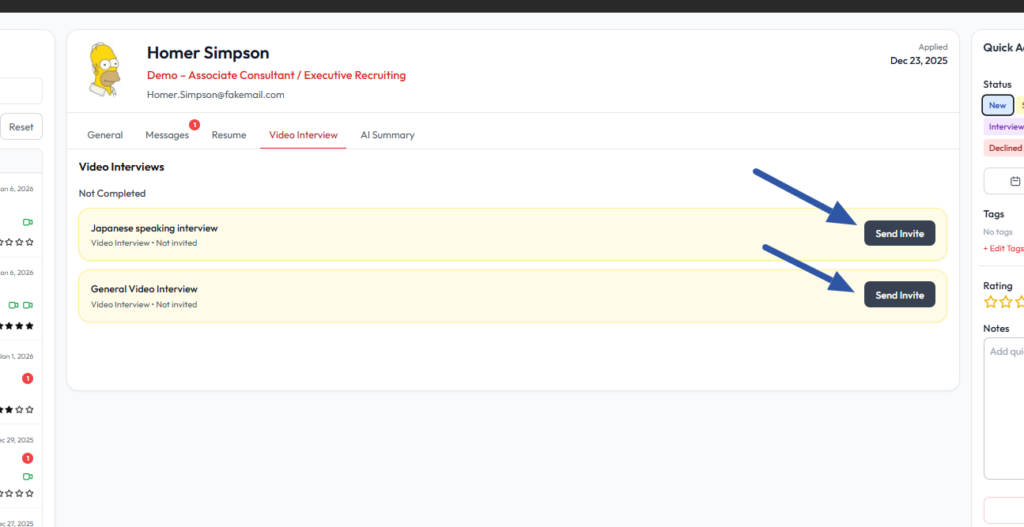
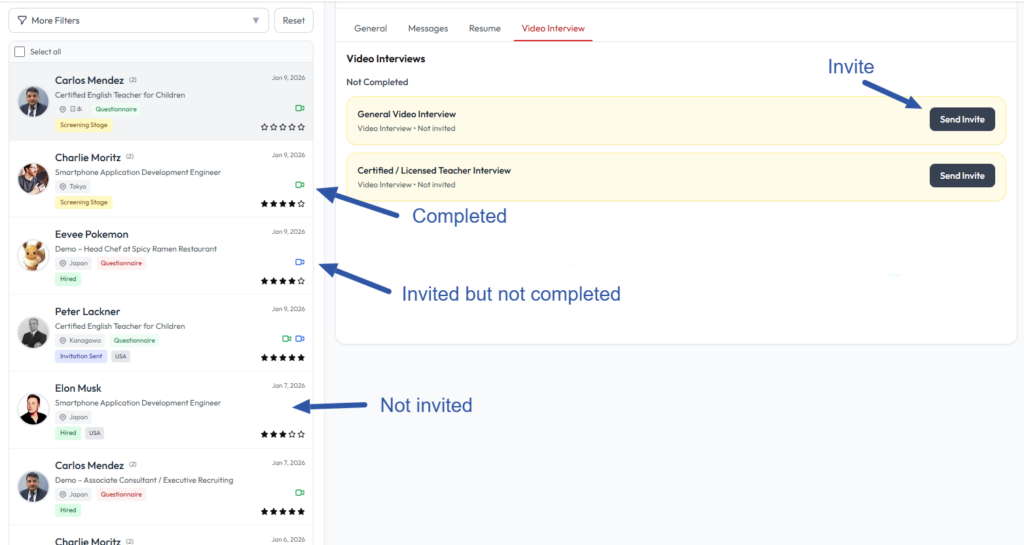
If the applicant hasn’t completed a video interview yet, you can invite them with a single click.  Video interview sets include:

  • General Video Interview – Any job seeker can take
  • Japanese language Video Interview – For jobs seekers with Business-level Japanese (JLPT N2) or above
  • Certified Teacher Video Interview – If profile shows the job seeker having an Education / Teaching degree, TEFL Certifications, or similar.

The AI Summary reviews the applicant’s resume, cover letter, and screening question responses against your job advertisement, and then organizes the information so you can quickly see where the applicant appears to meet—or not meet—your stated requirements.

Important note: the AI does not give advice, recommendations, or hiring decisions. It only extracts and organizes information from the applicant’s submitted materials and highlights relevant evidence tied to your criteria.

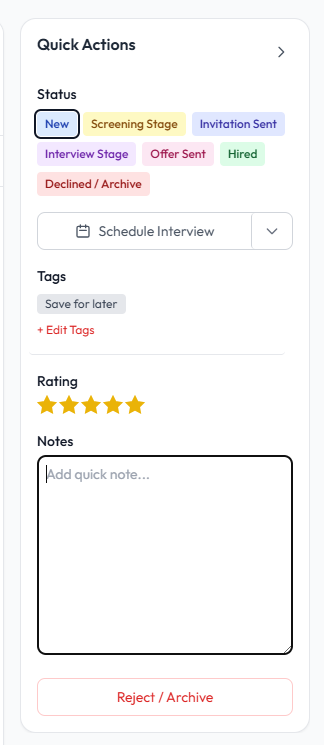
On the right side, you can manage everything you typically do while evaluating applicants such as:

  • Update status
  • Add tags
  • Set ratings
  • Add notes

As you make changes here, you’ll see those updates reflected in the applicant list on the left.

You can also schedule interviews using the scheduling option, which can link to tools like Google Calendar, Outlook, Apple Calendar, or Calendly.

Since you won’t be moving forward with every applicant, you can use Archive to remove applicants from your active list while keeping their record accessible.

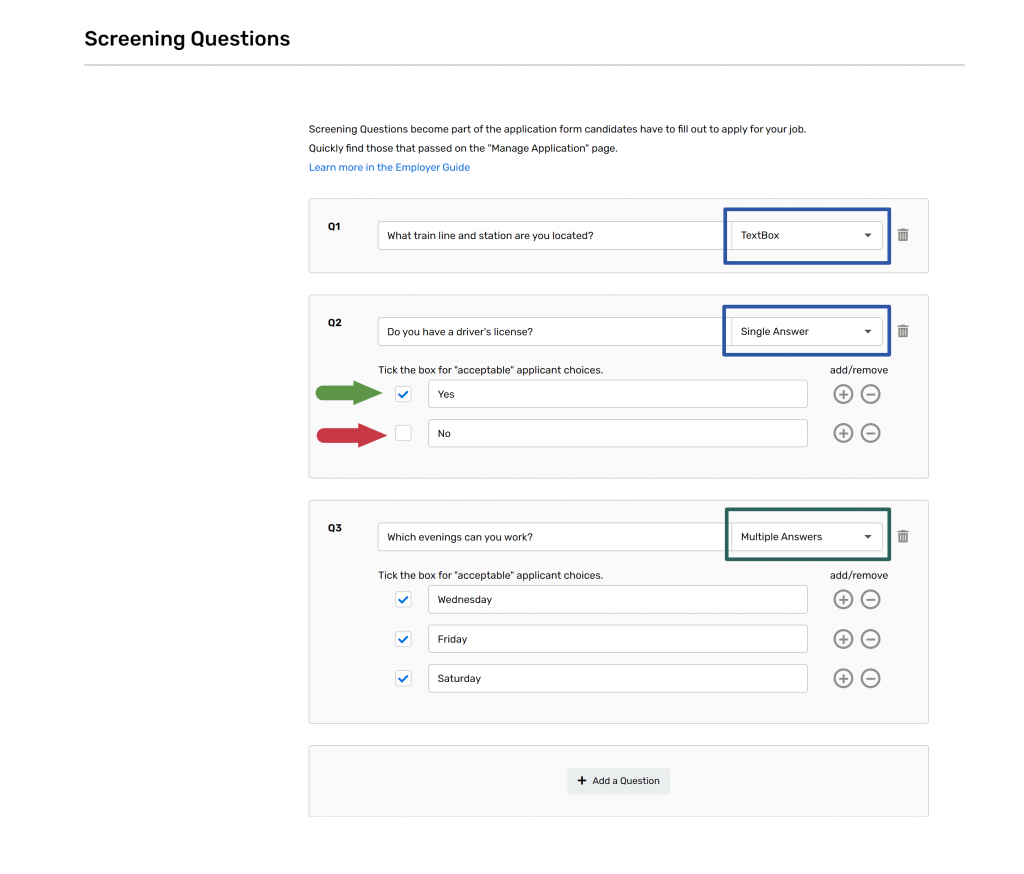
The Screening Questionnaire function will help you streamline your hiring process. Sometimes there is information you would like to know which may not be included in the resume.  With the Screening Questionnaire, you can ask a number of questions for the applicant to answer which will be displayed with the application.

A) Types of questions – You can ask for a written response (Text Box), Multiple Choice with one answer only (Single Answer), or Multiple Choice with many answers acceptable (Multiple Answers).

B) Questionnaire Failure – Please let the Acceptable Answer box un-checked if that response is not acceptable and denotes a Failing Score.

* Applicants do not know they pass or fail the questionnaire.
* Maximum of five questions.

C) See Results at a single glance – In the list of applications, you will see the results with green denoting  “passing” and red denoting “failing.” The Profile tab will show the details of the responses given.

The First Round Video Interview is a great way to screen applicants. Our automated system asks job seekers a number of set interview questions allowing you to better evaluate a large number of applicants quickly.

Many of our employers love and rely on the first round interview because:

  1. It saves a lot of time Scheduling interviews
    When you try to schedule face-to-face interviews, it can be difficult to find a time that suits everyone. Now multiply that by five, ten, or even twenty candidates, some of whom might be overseas, and you have a scheduling nightmare.Using the First Round Video Interview, scheduling isn’t an issue because the candidate can complete the interview on their own time, and you can watch them anytime as well.
  2. Structured and Easier to Judge
    Because each candidate gets the same questions and the same amount of time to answer, this makes it much easier to see who is a good fit for your position and eliminates hiring bias.
  3. Share with team members
    Owners, managers and hiring staff can all review the same videos and give their input, so you can each assess candidates in your own time. This greatly speeds up the hiring process.Instead of wasting your time talking to people who aren’t even close to what you’re looking for, use video interviewing software to quickly sort through and decide who’s a yes, who’s a no, and who’s a maybe. How many times have you held an interview where you know that the applicant is not a good fit almost immediately, but you had to waste everyone’s time being polite? Now you no longer have to have those awkward dead end interviews.
  4. Hidden Gems
    Sometimes an applicant’s resume or cover letter is not that impressive, but when you see the person their personality shines and you realize they would be a perfect match. We hear so many times “We found a great employee. If it was not for the video interview, we would not have even invited them for a live interview!”

A) Completed video interview – Select the video interview taken (if multiple) and view the responses.

B) Questions asked – There are three different video interviews: General Video Interview, Certified Teacher Interview and Japanese speaking interview.

General Questions

  1. Can you tell me a little about yourself?
  2. Why did you come to Japan? / Why do you want to come to Japan?
  3. What would you say are your strengths?
  4. What are you passionate about?
  5. What do you like to do outside of work?
  6. Can you speak Japanese? Please demonstrate if able.

Qualified Teacher Questions

  1. Can you tell me a little about yourself?
  2. Why did you come to Japan / Why do you want to come to Japan?
  3. What professional development classes, workshops, training, etc. have you recently attended? What are you learning right now?
  4. How would you engage a reluctant student?
  5. What do you like to do outside of work?
  6. Can you speak Japanese? If you can, could you please demonstrate your speaking ability.

Japanese Speaking Ability Questions

  1. 簡単に自己紹介をお願いします。(Please introduce yourself)
  2. 日本に来た理由を教えてください。もしくは日本に来て働きたい理由を教えてください。(Why did you come to Japan? Why do you want to work in Japan?)
  3. 今まで経験した仕事について、またはその仕事で得たスキルについて教えてください。(Please tell me about your work experience or work-related skills that you may have?)
  4. 趣味など何か好きな事についておしえてください。(What are your hobbies and/or interests? )
  5. 英語で簡単な自己紹介をお願いします。(Please introduce yourself in English )

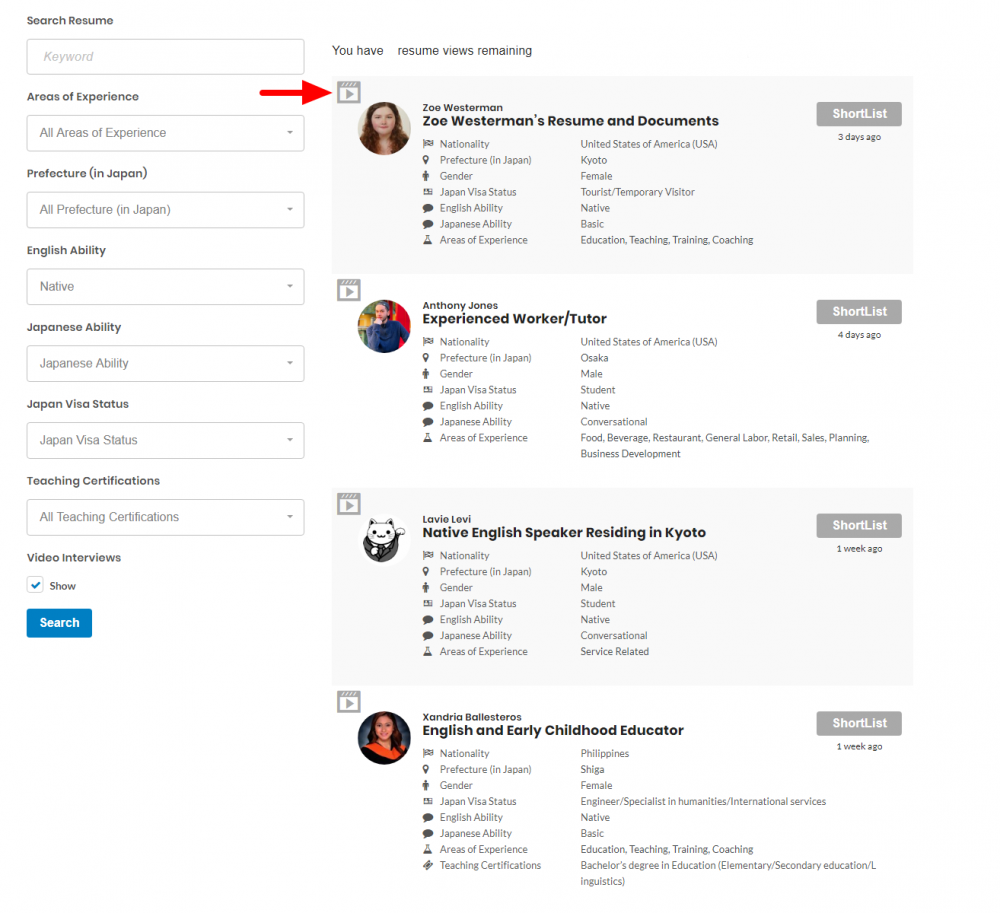
C) Inviting Applicants to take the video interview  – In the list of applications, you will see the video icon denoting if the video has been completed (green), invited (blue) or not invited.

If the employer clicks the “invite” button, a customized video interview invitation email will be sent to the applicant asking them to take the First Round Video Interview. After being invited, the icon will turn blue denoting that an invitation has been sent but not completed.

Employers sometimes ask us about how to increase the response to their job listings. While there can be any number or reasons (i.e., compensation, location, requirements, etc.), the issue is often a poorly written job description.

Just as employers only skim the first part of a resume or cover letter, job seekers do the same with job postings. If it does not attract their attention, they move to the next opportunity advertised.

Tone of the job description

Employers often make the mistake of only including their requirements instead of appealing to what would motivate a candidate to apply for the job. In addition to your needs, you will need to write your job description, which is an advertisement, to include items that would relate to their personal and professional goals, interests or other items which may motivate them.

Just remember to “think like an applicant” and write what would make you apply for the job.

Job Title

Specific job titles are better than general ones. One should describe the role accurately.
Bad Title: Teacher
Good Title: Certified Children’s English Teacher

Bad Title: Programmer
Good Title: Senior Computer Programmer with C++ proficiency

Job Description

Here are some items that can be found in an effective job description:

  • Attention-grabbing opening: Open with a strong, attention-grabbing summary which provides an overview of your company and expectations and responsibilities for the position.
  • Why is your company and position special? There is a lot of competition for the best candidates and explaining why your company and job are great will get you candidates that want your job, not any job, even at a lower salary.
  • Highlight the day-to-day activities of the position. This will help candidates understand the work environment and the activities they will be expected to perform on a daily basis.
  • List of skills required (hard and soft) – make sure the job description explains the level of required education, language ability, experience necessary, certifications and technical skills for the role. You may also include soft skills, like communication and problem solving, as well as personality traits that you envision for a successful hire.
  • Make your list of requirements concise. You are not making a shopping list or a wish list! Only list the absolute requirements, not a list of everything the ideal candidate possesses. Keep your list concise. It is rare for you to find a candidate that possesses everything you are looking for. If you give a huge list of required skills, you will scare potential applicants away and may miss out on applications from great candidates who would make fantastic employees with just a little extra training.
  • Peace of Mind. Especially for smaller and newer companies, you will want to explain why the job seeker should feel comfortable joining your company.

Salary

Listings that do not include a salary (or salary range) get far fewer applications than those that do. Even if the salary range is very wide, it is good to list what this is and what must be done to achieve the hiring listed salary.

Terms like: competitive pay, salary negotiable, compensation commensurate with experience, market rates and uncapped bonuses scare away potential candidates. It tells the job seekers little and is one of the “red flags” for avoiding a bad company. While your intention may be to pay qualified candidates a higher salary, it gives the impression that you will try to negotiate them into a lower salary.

Benefits

Be sure to list both the monetary and non-monetary benefits of the job. If you offer company housing, be sure to mention it along with the market rate for the apartment in your area.

Other benefits can include training, opportunities for advancement, location, flexible working hours, health insurance, professional development, etc.

Company Profile Page

All postings on Jobsinjapan.com include a Company Profile page (update the Company Profile at the My Profile folder).

While it is informative to state the facts about your company, be sure to use this page to give the job seeker some information that they cannot find on your company’s website. For example, you can write about: 1) Why is your company a great place to work, 2) Company culture, 3) Employee benefits, etc.

Reducing the number of unqualified applications

Applying to jobs online is too easy, just a few clicks is all it takes. While convenient for the job seeker, it also encourages them to apply for jobs which they are quite qualified for. This is not just with Jobsinjapan.com but with all online job resources.

To address this problem, jobsinjapan.com has a Screening Questionnaire function where you can filter out only relevant applicants, saving you time, by “testing” them when they apply for your job.

Job Posting Guidelines

The following guidelines will help you develop job content and recruiting practices that are consistent with Jobsinjapan.com’s standards for an optimal job seeker experience. JobsinJapan.com reserves all editorial rights to edit job postings and may refuse to post a job that does not adhere to the guidelines herewith. 

General Recruitment

  • Use JOBS IN JAPAN to fill an actual job, not a pipeline or resume mill. Each posting should represent a real and currently available job. Listings that prove misleading, compromise the job seeker experience or those which we are not convinced represent a “real” job may be removed from the site altogether. 
  • If a position is filled during the posting period, the employer is to de-activate the listing to avoid damaging the reputation of the employer and JobsinJapan.com
  • Job postings must not contain multiple positions (must be created as separate job postings). One cannot mix full time and part time, prefectures, etc. unless given prior approval.  
  • In principle, jobs must be listed by prefecture and not have area (i.e. Kanto Jobs) or multiple areas (Position in Osaka, Tokyo, Nagoya)
  • Maintain dignity and respect for all people, and do not post ads that may be insulting or offensive, e.g., “Caucasian teacher wanted, “Japanese only,” “female secretary wanted,” etc.  Keep the focus on qualifications, e.g., “native English speaker” or “native Japanese speaker.” If there is an age, gender, nationality or other specification due to a unique circumstance, include a reasonable explanation if not already clear, e.g., “black female extra, early 20’s, for TV show,” “American citizen for job on U.S. military base” or “ABC Church seeking Christian teacher.” 
  • Pay reliably and fairly. Jobs that people find on JobsinJapan.com should have hourly or salaried wages and should not cost the candidate anything to apply, interview and begin work. 
  • Job postings must not require the user to “email for more details”; position details are to be listed in the job posting.
  • Make application accessible and transparent. Job seekers should not have to set up or navigate through complicated steps to begin the application process. 
  • Respect candidate privacy. Information gathered in the application process should be shared carefully within your company and never made available to third parties.

Job Titles and Descriptions

  • Leave clickbait out of titles. Job titles should be the name of the particular job as it might appear on a business card, with no extra information. This point is particularly important when ads may be fed out to affiliated sites. The job description is where work location, required degrees, company perks and other specifics should be detailed. 
  • Do not use job content that is not yours. Each job that appears on JobsinJapan.com must be offered by an authorized representative of the company seeking to fill a position. Agents taking fees to introduce employees to other companies are not permitted unless the agent has a dispatch or introduction license issued by the Japanese government and that license number is displayed in the posting. 
  • Offer a real job. JobsinJapan.com is a search engine for jobs. Nonjob content–including spam, scams and other offers–will be taken off the site. 
  • Job titles should not contain odd characters (e.g., xxxxx), symbols (e.g., stars, asterisks), ALL CAPITAL LETTERS, or information that belongs in the job description such as location, wage, benefits, etc. Avoid phrases such as “URGENT” or ****ENGLISH TEACHER NEEDED HURRY !!!!!!!!. It is acceptable to explain the position start time:  Marketing Manager – Immediate Start. Provide the true details of your job, including its location, duties and whether the job is `being offered by the hiring company or by a recruiter on the company’s behalf.
  • JobsinJapan.com reserves all editorial rights to edit job postings, decline a posting, or remove a posting at any time. 

All postings have to be in accordance with our Terms of Service 

Listings that prove misleading, compromise the job seeker experience or those which we are not convinced represent a “real” job may be removed from the site altogether.

Contact Us

Tokyo Office
C/O Global Village Media
1-7-20-B2 Yaesu, Chuo-ku, Tokyo
[email protected]