
JOBS IN JAPAN vs recruitment agencies: employer comparison
Which option fits your hiring needs?
A job board helps you attract applicants; a recruitment agency can do more of the search and selection work. JOBS IN JAPAN is worth testing when your team can manage hiring. A specialist recruiter can be worth the additional cost when the search is confidential, highly specialized or difficult to resource internally.
Initial research checked 6 September 2026; fee and direct-hiring additions checked 23 September 2026. Prepared by JOBS IN JAPAN, one of the services compared. Recommendations reflect our assessment, not a measured ranking of hiring results.
How much does it cost?
JOBS IN JAPAN Standard is ¥24,200 and Premium ¥44,000 for 30 days, tax included. Agency fees depend on the provider and engagement: success-based placement, retained search and outsourced recruiting must not be treated as one price model.
Pricing references: JOBS IN JAPAN packages · Recruit Agent: fee model and calculation.
Features compared
| Feature | JOBS IN JAPAN | recruitment agencies |
|---|---|---|
| What you buy | Advertising and employer tools in the posting packages compared here. | Recruiter time, sourcing and candidate introduction; scope depends on contract. |
| Finding candidates | Applications to your listing; resume-bank access in eligible packages. | Agency-led search and outreach; specialist networks can matter. |
| Screening responsibility | Your team sets criteria and reviews candidates. | Recruiter can assess and shortlist; employer makes the hiring decision. |
| Video / AI / tracking | Platform tools help your team manage selection. | Methods and tools differ by agency. Ask what work is actually included. |
| Cost exposure | Posting spend is incurred even if nobody is hired. | Payment triggers, minimum fees and retainers depend on the agreement. |
| After an unsuccessful hire | Do not assume a job advertisement includes replacement recruitment. | Refund or replacement conditions may apply; inspect the specific terms. |
| Financial incentive | Advertising fee for the package, not a success fee for a particular hire. Your team assesses applicants directly. | With success-fee recruitment, payment depends on the agreed hiring outcome. Evaluate recommendations with that financial incentive in mind. |
| Application Authenticity | Applications come directly from candidates, who may still use AI or outside writing help. Test writing ability separately. | Ask whether the resume was edited or rewritten by the recruiter. Its wording is not necessarily the candidate's own work. |
| Effect of a higher salary | The fixed advertising package price does not rise because you offer a candidate more pay. | A percentage-based placement fee rises with the agreed compensation basis; other fee models differ. |
| Multiple hires and future vacancies | One campaign can produce several hires without JIJ per-hire fees. Retained applications can support future hiring, with appropriate permission and availability checks. | Per-hire charges and fees for later hiring of introduced candidates depend on the contract. |
| Who reviews the applicant pool? | Your team can review received applications and recognize strengths beyond the original brief. | The recruiter normally selects candidates to introduce; a clear brief helps them identify less obvious strengths. |
On smaller screens, swipe the table sideways to compare all three columns.
Features vary by package. "Not verified" means the checked material did not establish an equivalent feature; it does not mean the feature is absent. JOBS IN JAPAN Standard allows viewing existing video interviews, while Premium includes invitations.
Feature sources: JOBS IN JAPAN employer features · Robert Walters Japan permanent recruitment: example service scope · Robert Walters RPO: a distinct service model.
How are recruitment agency fees calculated?
Recruit Agent describes success-based fees of around 35% of expected annual compensation as common. The calculation can include bonuses and specified allowances, not just basic salary. Actual rates and calculation rules depend on the agreement. Source: Recruit Agent, updated 9 June 2026.
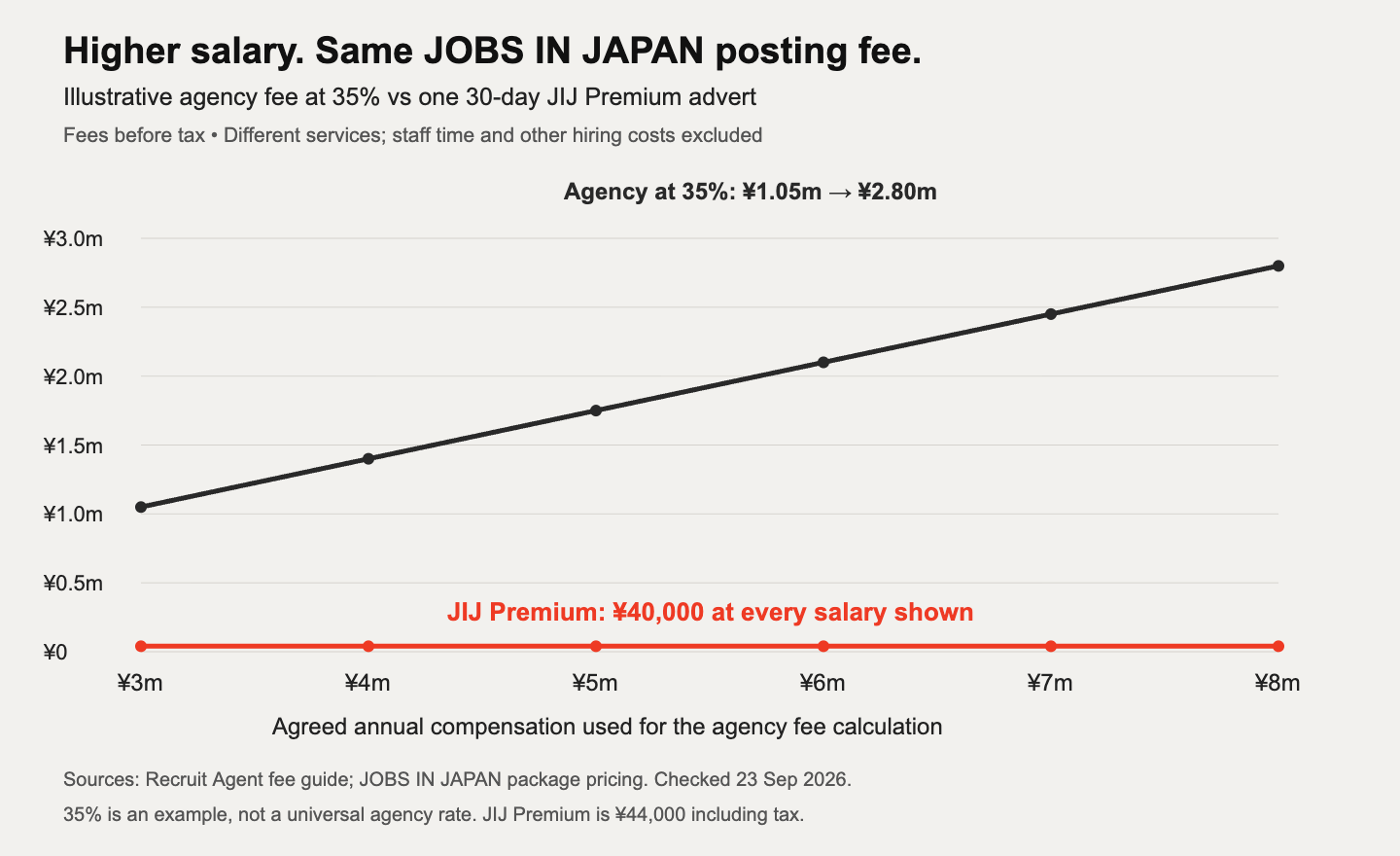
A higher salary does not increase your JOBS IN JAPAN posting fee
With a fixed-price JOBS IN JAPAN advertising package, offering a candidate more pay does not increase the advertising charge. With a percentage-based agency fee, a higher agreed compensation basis increases the placement fee.
Illustration: at 35%, a ¥4 million compensation basis produces a ¥1.4 million fee; ¥5 million produces ¥1.75 million. That is an extra ¥350,000 in placement fees, before applicable tax. The rate is illustrative, not a quote for every agency. Fee-basis source.
An agency may handle work your team would otherwise do. Include your team's screening time when comparing costs.
What other advantages does a job board offer employers?
One campaign can produce several hires and future candidates
A JOBS IN JAPAN advertising campaign can result in more than one hire without a separate JIJ placement fee for each person. Posting limits and any additional advertising still depend on the package. ManpowerGroup also notes that job advertising can have a cost advantage for multiple hires, while agency introduction fees are charged per hire. Source: ManpowerGroup.
Applications remain available after a JOBS IN JAPAN listing closes. A strong applicant you do not hire today may suit a later vacancy, a new location or a different schedule. With appropriate permission to retain details and reconnect, one campaign can support later hiring too. Check the person's current interest and availability; an old application is not a promise that they are still looking.
Review the applicant pool yourself
Your team can review the applications received rather than only an agency's shortlist. You may recognize useful strengths a recruiter did not know mattered: experience with a particular age group, another language, a practical skill or availability that fits a second vacancy. You decide which of those strengths matter to your business. It also means your team takes on more screening work.
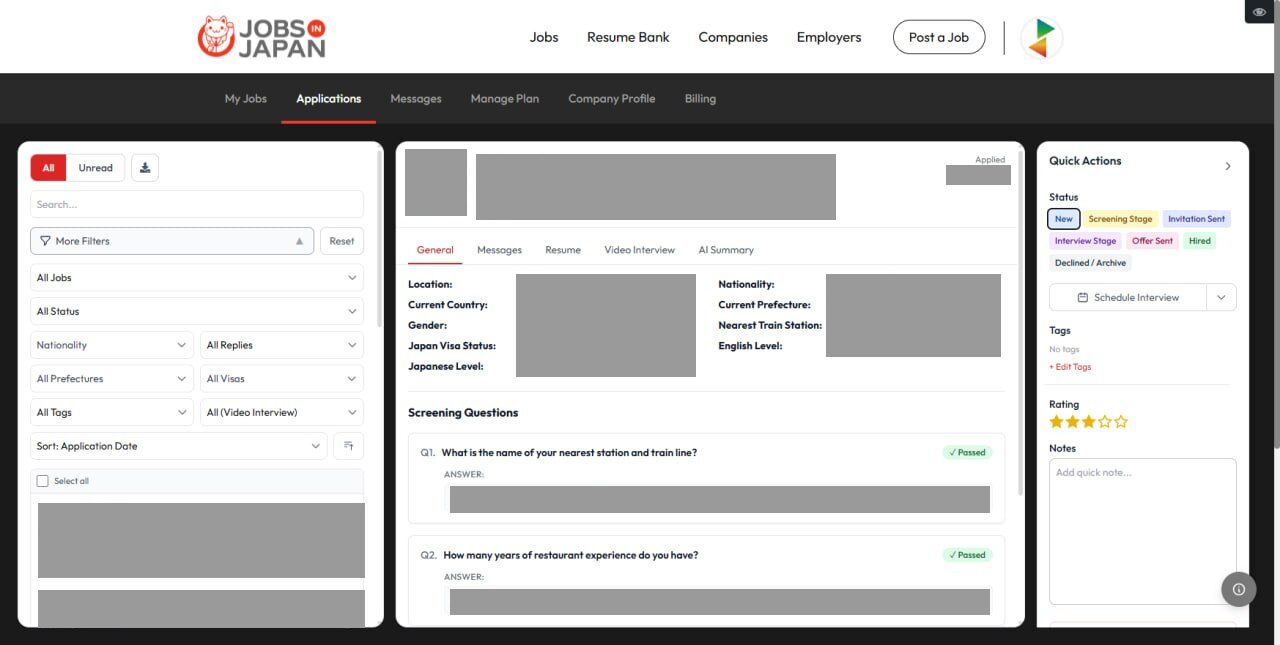
Control your message and learn directly from applicants
You describe the role, pay, schedule and working environment in your own terms. Direct questions and conversations help you understand what attracts candidates and what puts them off. That feedback can improve both the current vacancy and your next recruitment campaign.
Your advert does not depend on a consultant prioritizing the assignment
A paid listing gives your vacancy advertising exposure without depending on a recruitment consultant choosing to work it. In its discussion of refund-guarantee periods, ManpowerGroup explains that consultant incentives and payment timing can influence which employers receive attention. This supports checking commercial incentives, not assuming misconduct. Advertising exposure itself does not guarantee suitable applicants. Source: ManpowerGroup, updated 25 June 2026.
Potential risks to consider when using a recruitment agency
A success-fee recruiter has a financial interest in the hire
Under a success-fee arrangement, the agency earns its placement fee when the agreed hiring conditions are met. The agency has a financial stake in your decision. Its recommendation should not be treated as a neutral, independent assessment. Part of the recruiter's role is selling you on the candidate.
That creates a risk of overselling strengths or giving less attention to weaknesses. It does not mean every recruiter exaggerates: good recruiters also have reasons to protect their reputation and build repeat business. Treat the recommendation as a case to evaluate, not proof of suitability. Ask for evidence behind claims, discuss gaps directly with the candidate and assess candidates against the same job requirements.
An edited resume is not a writing sample
Ask whether the resume you receive is the candidate's original submission or a version edited, rewritten or summarized by the agency. If the recruiter has shaped the wording, its polish is not evidence of the candidate's own writing or language ability.
A tailored presentation can make relevant experience easier to find, but it can also make a candidate's responsibilities or expertise sound stronger than the underlying evidence supports. Ask the candidate to explain specific achievements and their personal contribution. If writing matters to the role, use a short, job-relevant writing task under clearly agreed conditions.
Direct hiring lets you assess applicants without a placement sales pitch
With the JOBS IN JAPAN advertising packages compared here, your team receives applications and decides whom to interview and hire. You can speak directly with candidates and use screening questions and video interviews to form your own view, without an agency intermediary advocating for a particular placement. JOBS IN JAPAN is paid for the advertising package, not a success fee for persuading you to hire a specific applicant.
Direct applications are not guaranteed to be unassisted: candidates can use AI, translators or resume-writing services. The advantage is direct access and control over assessment, not a guarantee that every word was written independently. Employers make the final hiring decision under either model.
The incentive discussion concerns success-fee recruitment, not every agency contract. Human Resocia's published terms provide one example of a placement-fee arrangement; they are not evidence of exaggeration or resume rewriting. The assessment points above are JOBS IN JAPAN's guidance, not allegations about any specific agency.
Which gives employers a better return on investment?
Compare total channel spend and staff time with suitable applicants, interviews and hires. Use the same vacancy, requirements and test period. Count a suitable applicant only when they meet the role's required skills, language level, location and work eligibility. Report duplicate candidates separately. Lower advertising cost alone does not prove better hiring results.
A JOBS IN JAPAN campaign example: Jewel Tours Japan
Jewel Tours Japan reported 74 applications, 12 live interviews and four part-time freelance guides added from ¥44,000 in advertising. That is ¥11,000 in advertising spend per guide, excluding staff time and other hiring costs. The figures come from the employer-supplied case-study information. This is one campaign, not a typical-results promise or a head-to-head comparison with an agency.
Employer FAQ
Does direct recruiting always avoid success fees?
No. BizReach lets employers search and approach candidates directly, but its FAQ describes monthly database-access charges plus a success fee for each hire. It is a direct-recruiting platform, not the same service model as a conventional agency or a fixed-price job advertisement. Compare the charging model as well as who contacts the candidates. Source: BizReach employer FAQ, checked 23 September 2026.
Can one job advertisement produce multiple hires?
Yes. A JOBS IN JAPAN campaign can produce several hires without a JIJ per-hire placement fee. Suitable applicants may also become contacts for later vacancies, with appropriate permission and renewed checks of their availability. Results vary; advertising is paid for even if no hire is made.
Does an agency refund guarantee a successful hire?
No. ManpowerGroup describes refunds that depend on conditions and how soon someone leaves, and may cover only part of the fee. Check the actual agreement, including exclusions. A refund does not recover all the time spent recruiting and onboarding. Source: ManpowerGroup.
Should I try a job board before an agency?
Consider it if the vacancy can be advertised and your team has time to handle selection. For a confidential or specialist search, agency support may be the better starting point.
Do all agencies charge 35%?
No. Recruit Agent describes around 35% as common, but rates vary. Obtain the fee basis, minimum, tax treatment and payment trigger for your own engagement.
Can I use a job board and agency together?
Potentially. Before doing so, check exclusivity, duplicate-candidate rules and fees for previously introduced candidates. Keep a record of each candidate's source.
Sources for the added comparisons
Checked 23 September 2026. These are provider explanations, not independent comparative research.
Recruit Agent: recruitment fees and calculations. Updated 9 June 2026. Supports the percentage-based fee explanation.
ManpowerGroup: introduction fees, refunds and recruiting models. Updated 25 June 2026. Supports the discussion of consultant priorities, conditional refunds and multiple-hire economics. Its fee ranges differ between the main text and summary table, so this page does not use them as a market-average estimate.
BizReach employer FAQ. Supports the distinction between direct recruiting and hiring without success fees.
Jewel Tours figures: employer-supplied JOBS IN JAPAN case-study materials. The case study remains unpublished. Applicant-review and employer-message benefits are JOBS IN JAPAN's assessment.
Test JOBS IN JAPAN with your next vacancy
Start with Standard at ¥24,200, or choose Premium at ¥44,000 for featured placement, video interview invitations and resume-bank access. Both run for 30 days. Review the package details and choose the tools your team will use.