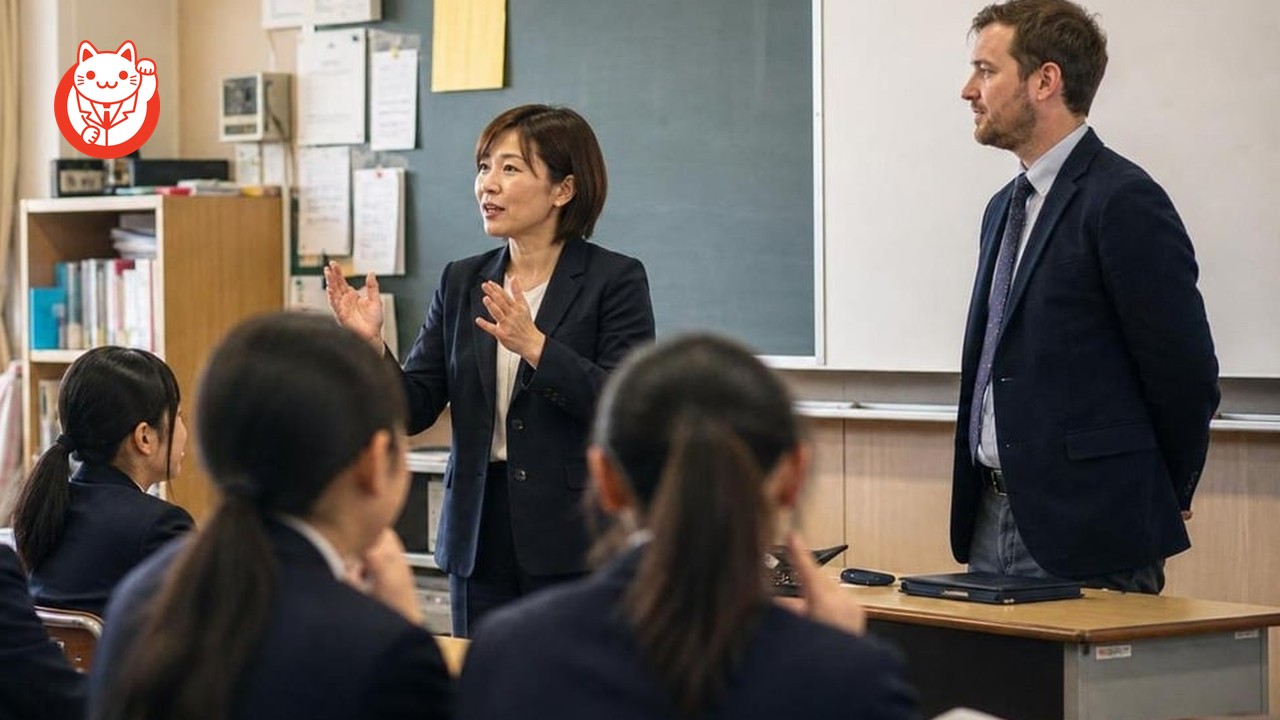
One of the questions I hear most often from ALTs is surprisingly simple.
"Why does my friend teach every class while I mostly assist?"
Sometimes the question is asked with curiosity. Sometimes it comes with frustration. It is easy to assume that being given full classes is a sign of trust or professional recognition, while spending more time supporting a Japanese teacher somehow reflects a lack of confidence.
In reality, the answer is usually far more complicated. As with several of the topics I have explored in this series, there is rarely a single explanation. Being given full classes is seldom a reward, and not being given them is seldom a criticism. More often, it reflects the particular circumstances of a school, the teachers involved, and the relationships that have developed over time.
Every School Starts from a Different Place
Earlier in this series, I wrote about ESID, or "Every Situation Is Different". Few topics demonstrate this more clearly than who teaches the lesson.
Some schools expect ALTs to take a leading role in communicative activities from the beginning. Others see the ALT primarily as someone who supports lessons designed by the Japanese teacher. In some schools, the balance shifts naturally over time as relationships develop. In others, the pattern remains largely unchanged throughout the year.
None of these approaches is automatically right or wrong. They simply reflect different interpretations of the ALT role, different school cultures, and different educational priorities. Part of the reason this variation exists is that the ALT role itself has never been defined in precise operational terms at the national level. Schools are therefore left to interpret what effective use of an ALT looks like within their own contexts.
For a new ALT, this can be confusing. It is tempting to compare your experience with someone else's, but those comparisons often overlook the context in which each person is working.
Teaching a Full Class Requires More Than Teaching Ability
One assumption many people make is that teaching whole classes depends primarily on ability. Of course, teaching experience, confidence, and good communication all matter.
But they are only part of the picture.
When a Japanese teacher decides to hand over more responsibility, they are not only thinking about the lesson itself. They are also considering whether expectations have been discussed clearly, whether communication is working smoothly, and whether both people have developed enough confidence in one another to make the lesson successful.
That confidence takes time to build, which is one reason I have written repeatedly about relationships throughout this series. The strongest professional partnerships are rarely created in a single planning meeting. They develop gradually through consistency, communication, and shared experiences in the classroom.
The Japanese Teacher Matters Too
Another point that is sometimes overlooked is that Japanese teachers are not all working under the same conditions.
Some are highly experienced English teachers who have worked with many ALTs over the years. Others may be early in their careers or working with an ALT for the first time. Some enjoy collaborative lesson planning, while others have inherited routines that have changed very little over time. Workload also plays an important role. As I discussed in a previous article, Japanese teachers carry many responsibilities beyond classroom teaching, and their decisions about who leads a lesson are often shaped by practical realities rather than educational philosophy alone.
I was reminded of this only recently. One teacher I work with is very happy for me to take full classes while he supports from the back of the room. A few days before a Board of Education observation, however, he asked if he could teach the lesson himself because he wanted to practise the lesson he would later demonstrate. It was a perfectly reasonable request, so I supported the lesson instead, and afterwards we discussed how it had gone together.
Nothing about our professional relationship had changed. The lesson simply had a different purpose that day, and experiences like these are useful reminders that classroom roles often shift according to circumstances rather than fixed rules.
Experience Looks Different from What Many People Expect
Experience certainly influences opportunities, but perhaps not in the way people imagine.
An ALT with many years of teaching experience may still need time to understand a particular school. At the same time, an ALT with fewer years in education but a long history within the same community may already have developed strong relationships with teachers, school leaders, and the local Board of Education. Those relationships matter because, over time, roles often emerge naturally as colleagues gain confidence in one another.
Responsibilities that seemed unlikely during the first few months may become entirely normal after several years. Like the professional relationships themselves, that process cannot easily be rushed.
Sometimes the ALT Prefers Not to Teach
It is also worth remembering that not every ALT wants to lead full classes.
Some enjoy working alongside Japanese teachers and see that partnership as one of the most rewarding aspects of the role. Others prefer the supporting position because it allows them to focus on pronunciation, communication, or individual interaction with students.
There are also ALTs who read their contracts carefully and conclude that leading classes falls outside what they believe they were employed to do. Some are quite happy to maintain that position throughout their time in Japan.
Again, there is no single right answer. The important point is that different expectations exist on both sides of the partnership. Schools have their own assumptions, and ALTs bring their own professional experiences, preferences, and goals.
Looking Beyond the Classroom
One theme has appeared repeatedly throughout this series. Whether we are discussing role ambiguity, evaluation, or team teaching, many of the most important aspects of ALT work are shaped by the environment surrounding the classroom rather than by the lesson itself.
Who teaches a particular class is no different. It is influenced by school culture, professional relationships, previous experiences with ALTs, the confidence of the Japanese teacher, workload, communication, and the practical realities of a particular day.
That is why it is so difficult to compare one ALT's experience with another's.
A Better Question
Instead of asking,
"Why am I not teaching full classes?"
It may be more helpful to ask,
"What does this school need from me at this stage?"
The answer may change over time.
As relationships develop, expectations often change with them. Many ALT roles are not assigned once and for all at the beginning of the year. They emerge gradually through trust, communication, and experience.
Understanding that was one of the most important lessons I learned during my own time in Japanese public schools. It also changed the way I viewed the role itself.
The classroom is where ALT work is most visible. The relationships behind it are often where the role is really shaped.