
Quitting a job in Japan can feel more formal than it needs to be.
Some companies make it sound as if you have to explain your whole life plan before they will accept your resignation. You do not. In most normal cases, the company needs to know that you are resigning, when your final day will be, and enough practical information to finish payroll and send your documents.
They do not need your next employer, your new salary, your job-search history, or a dramatic explanation of why you are leaving.
This article is general information, not legal or immigration advice. Labor and immigration rules can change, and your contract type matters, so check the relevant official body or a qualified professional if your situation is disputed, high-risk, or tied closely to your visa.
1. What information do you actually have to give when you quit?
The short answer: give your company a clear resignation notice with your name, your intention to resign, and your requested final day.
That is the core of it.
In practice, a normal resignation notice in Japan includes:
- Your name
- Your department or position, if useful
- The date you are submitting the notice
- The company representative it is addressed to
- A simple statement that you are resigning
- Your intended final employment date
- A short reason, usually just "personal reasons"
You do not need to write a confession. You do not need to list everything wrong with the company. You do not need to tell them where you are going next.
A simple English version would be:
I hereby submit my resignation for personal reasons. My final day of employment will be [date]. Thank you for the opportunity to work with the company.
A simple Japanese version would be:
私儀、一身上の都合により、[date]をもって退職いたします。
That phrase, 一身上の都合, is the standard Japanese way of saying "for personal reasons." It is boring, but boring is exactly what you want here. This is one of the few times where I like how Japanese can be vague.
If you are handing in a Japanese-style resignation letter, the envelope is also usually kept plain. A common convention is to use a white, unmarked envelope and write 退職届 vertically on the front. On the back, people often write their department and full name in the lower-left area. This is office etiquette, not the legal core of resigning, but it helps the document look normal to a Japanese HR or admin person.
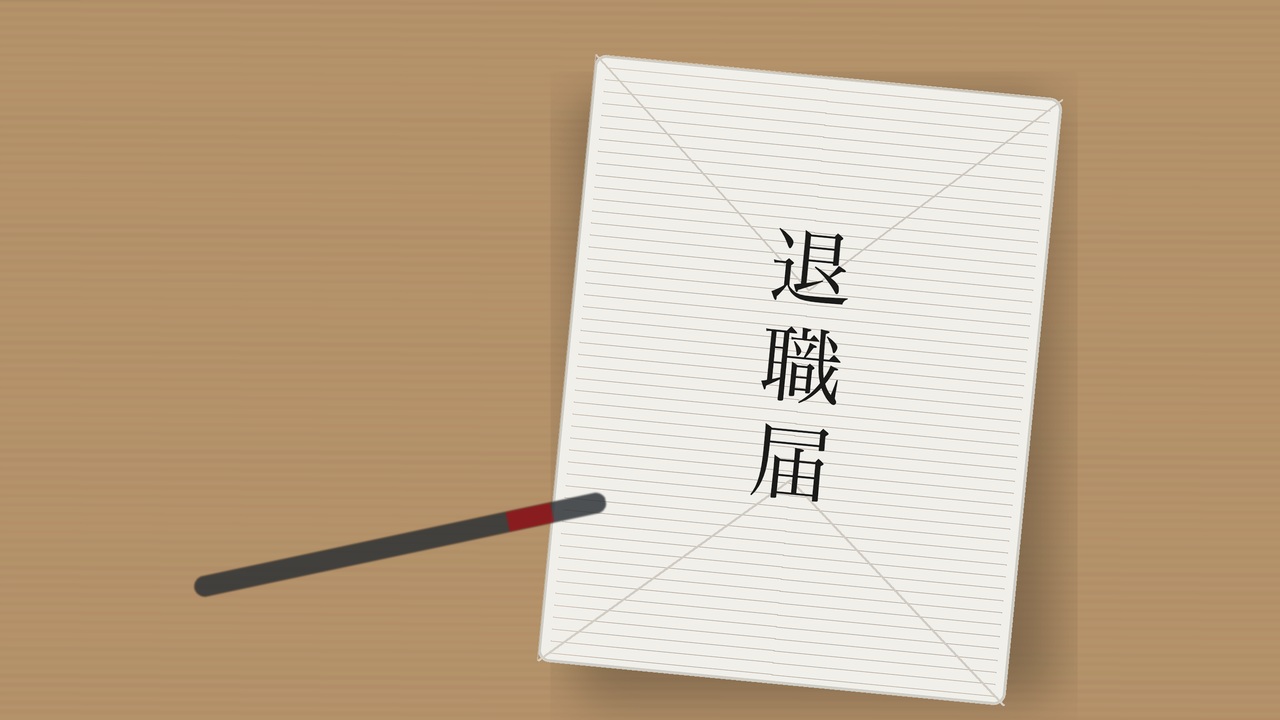
For a Japanese-language visual guide, Biz研 has a simple non-job-board explanation of how to write and prepare the envelope: 退職届・退職願の封筒の書き方・入れ方・提出方法を解説.
If your company uses a specific resignation form, it is usually fine to use it, but read it before signing. If the form says something different from what you intend, slow down and ask what it means.
2. How much notice do you need to give in Japan?
For an employment contract with no fixed term, the commonly cited legal rule is two weeks' notice. The Tokyo Foreign Employment Service Center, part of Japan's labor office network under MHLW, explains that under Civil Code Article 627, an indefinite-term labor contract ends two weeks after the employee requests cancellation of the contract.
JETRO's labor guide gives the same broad explanation for employees on contracts with no set term.
That said, this is where real life and legal minimums can pull in different directions.
Many Japanese companies ask for one month of notice in their work rules. Some schools, Eikaiwa chains, dispatch companies, and office jobs strongly prefer longer because they need to replace you, tell clients/BOEs, change class schedules, or hand over projects.
My practical advice is this:
- If the company is normal and you are not being mistreated, give as much notice as you reasonably can.
- If the company is pressuring you, withholding pay, or refusing to accept your resignation, do not let politeness, bullying or saying this is the way in Japan trap you.
- If you are on a fixed-term contract, check the contract and get advice if you are leaving before the term ends.
Fixed-term contracts can be different. JETRO notes that employees on fixed-term contracts may resign after one year has passed from the start of the contract term, and either party may cancel immediately if there are unavoidable reasons. That does not mean every fixed-term situation is simple. If you are breaking a one-year teaching contract after four months, check before you assume the same two-week rule cleanly solves everything.
If you are unsure what kind of contract you have, the JOBS IN JAPAN article on the different types of employment contracts in Japan gives more detail on the contract terms you are likely to see.
3. Do you have to tell them why you are quitting?
Usually, no. A general reason is enough. This is not the place to take a parting shot or try to do your remaining colleagues a solid by giving the company a truth bomb.
"Personal reasons" is the safest standard answer. In Japanese, that is 一身上の都合. It is not rude. It is not suspicious. It is the normal phrase. You may want to give a fuller explanation if you have a good relationship with your manager, but that is a relationship choice, not something you should feel forced to do.
You are leaving, so don't try to fix the company. Reasons I would avoid putting in writing:
- "My manager is impossible."
- "The company is badly run."
- "The pay here is a joke."
- "This contract is illegal."
Even if some of that is true, your resignation letter is not the place to be a whistle-blower or shed light on the company's problems. Keep the formal resignation clean. If there is a pay dispute, harassment issue, unpaid overtime problem, or labor-law problem, handle that separately and keep records.
There is a JOBS IN JAPAN article on what to do when your company violates labor laws in Japan that goes into more detail on dealing with bad employer behavior.
4. Do you have to tell them your next employer?
In most cases, no. Be prepared for them to ask as they will.
Your current company may ask where you are going. A friendly manager may be curious. A pushy manager may make it sound like they need the information for paperwork. Usually, they do not need the name of your next company to accept your resignation.
A simple answer is enough:
I have not finalized what I am sharing publicly yet, but I will make sure all company handover items are completed before my final day.
In Japanese:
まだ公表する内容を決めておりませんが、最終出社日までに必要な引き継ぎはきちんと対応いたします。
Or, if you want to be even shorter:
I would prefer to keep that private for now.
In Japanese:
申し訳ありませんが、現時点では控えさせていただきます。
There are exceptions where some information may become relevant. For example, if your current employer is handling company housing, a relocation repayment agreement, a non-compete discussion, or a visa document that genuinely involves them, the situation may need more care. For a non-compete, you are protected by the Japanese constitution and as long as you are not steeling anything (or poaching students if you are a teacher), you should not have anything to worry about.
But as a normal rule, your next employer is your business.
Also, be careful about badmouthing your current company to your next one. This comes up all the time in hiring. The JOBS IN JAPAN article Don't Talk Yourself Out of a Job explains why complaining too much about a past employer can make you look like the risk, even when you had a legitimate reason to leave.
5. What practical information can your company reasonably ask for?
A company does not need your whole future plan, but it can reasonably ask for information needed to close out your employment.
This may include:
- Your final working day and final employment date
- Whether you want to use remaining paid leave before your final day
- A forwarding address for tax, employment insurance, and separation documents
- A personal email address or phone number for final paperwork
- Bank account details if final salary or reimbursements need to be paid
- Return of company property, such as laptop, ID card, keys, uniform, teaching materials, or health insurance card
- Information needed to settle company housing, if you use it
- Information needed to calculate final commuting allowance or expense claims
If you are enrolled in company health insurance, you will usually need to return the health insurance card after leaving. If you have company housing, a company phone, a school apartment, or a guarantor arrangement through your employer, deal with that early. These are often the things that cause the ugly arguments, not the resignation letter itself.
If your company asks for your address, ask what it will be used for. A forwarding address for official documents is normal. Asking for your new employer's address is a different matter.
For people who are still learning Japanese paperwork habits, the JOBS IN JAPAN article on hanko and personal seals in Japan gives more background on why some offices still ask for stamps or formal-looking documents, even when a signature may be enough.
6. What documents should you ask for when you leave?
Do not only think about what the company wants from you. Think about what you need from them.
Before or shortly after your last day, ask about:
- Final payslip
- Withholding tax slip, called 源泉徴収票 or gensen choshu-hyo
- Employment insurance separation notice, called 離職票 or rishoku-hyo, if you need it for Hello Work
- Employment insurance card or employment insurance number, if applicable
- Certificate of employment or resignation, if you need one for a new employer, immigration, housing, or paperwork
- Social insurance loss certificate, if you need it for health insurance or pension switching
The MHLW-linked Tokyo Foreign Employment Service Center explains that workers applying for unemployment benefits at Hello Work need documents such as the separation notice, called rishoku-hyo, and employment insurance card, if applicable.
Do not wait until months later if you can avoid it. Companies can be slow. Small schools and small businesses can be especially slow because payroll may be handled by the owner, an outside accountant, or one overworked admin person.
A useful sentence is:
Could you please let me know which documents I will receive after resignation, and approximately when they will be issued?
In Japanese:
退職後に発行いただける書類と、その発行時期を教えていただけますでしょうか。
7. What about your visa or status of residence?
Your company does not usually receive your immigration notification for you. For many work-related statuses of residence, the foreign resident personally has to notify the Immigration Services Agency when the relationship with the contracting or accepting organization ends, and again when a new one begins.
The Immigration Services Agency's pages on notifications concerning contracting organizations and activity organizations state that covered mid- to long-term residents must notify Immigration within 14 days when the contract with the organization ends, when they leave the organization, or when they enter into a new contract or transfer to a new organization.
For many readers, this applies to statuses such as Engineer/Specialist in Humanities/International Services, Highly Skilled Professional, Skilled Labor, Specified Skilled Worker, Instructor, Professor, Business Manager, and others listed by Immigration. The exact category depends on your status of residence.
The practical point is simple:
- Telling your company you quit is not the same as notifying Immigration.
- Your company may have its own reporting duties, but that does not replace your personal duty if your status is covered.
- Keep proof that you submitted the Immigration notification.
You can usually submit the notification online, by mail, or at a regional immigration office, depending on the procedure. Immigration says the online notification system is available 24 hours a day, and for the relevant organization-notification pages, it says supporting documents are not required when using the online notification system.
If your new job is in a different type of work, check whether your current status of residence actually allows it. For more detail, read the JOBS IN JAPAN article on what work your visa actually allows you to do in Japan. This matters especially when moving between teaching, office work, IT, hospitality, and part-time side work.
8. Can the company refuse to accept your resignation?
For a normal indefinite-term employee, a company generally cannot trap you forever by saying, "We do not accept your resignation."
That does not mean every resignation is frictionless. Some employers delay, guilt-trip, demand another meeting, or say the president has not approved it. I have seen this most often in small schools, dispatch work, and companies that are already understaffed.
Keep calm and make the resignation clear in writing. If you only have a verbal conversation, the company can later claim the date was unclear.
A practical message is:
As discussed, I am submitting my formal resignation. My final day of employment will be [date]. Please confirm the handover process and any company property I should return.
In Japanese:
お話ししましたとおり、正式に退職届を提出いたします。退職日は[date]を希望しております。引き継ぎの進め方と返却すべき会社備品についてご確認いただけますでしょうか。
If the company refuses to take the letter, consider sending the notice by email as well, or by a trackable method if things have become serious. Keep copies.
If there is a real dispute, talk to a labor consultation office, a lawyer, or a qualified labor and social security attorney. Do not rely on internet comments when your pay, visa, housing, or final documents are at risk.
Peter’s Advice
Some employers will try to make you feel guilty for leaving. Some will go further and threaten you with bad references, visa trouble, withheld documents, angry parents, angry clients, or damage claims if you do not stay longer.
Do not panic just because the conversation becomes emotional.
If you have already given the notice required by law, your contract, or a sensible agreement with the company, then any extra time you give is cooperation. It is a favor to the company. It is not something they own.
Of course, it is usually better to leave professionally. Give a proper handover. Put class notes, client details, passwords, lesson plans, or project status somewhere your replacement can use them. Do not burn a bridge just because you can. Japan can be a small market, especially in teaching, international schools, recruiting, hospitality, and foreign-facing office jobs.
But respect is a two-way street. If the employer threatens you, stop debating and start documenting. Keep copies of messages. Write down dates and names after meetings. If the threat involves pay, documents, housing, or your visa, get advice from a labor consultation office or qualified professional.
9. Should you use paid leave before your last day?
If you have unused paid leave, ask about it early and in writing.
In Japan, employees who meet the conditions for annual paid leave generally have the right to use it, but resignation timing can make things tense. Some companies will cooperate. Some will complain that it hurts the schedule. Some will suddenly discover a fake emergency that requires you to work until the end.
Do not spring this on them at the last possible second unless you have no choice.
A practical sentence is:
I would like to use my remaining paid leave from [date] to [date], with my final employment date as [date]. Please confirm my remaining paid leave balance.
In Japanese:
[date]から[date]まで残っている有給休暇を使用し、退職日は[date]としたいと考えております。現在の有給休暇の残日数をご確認いただけますでしょうか。
If you are an English teacher, ALT, preschool teacher, or eikaiwa employee, check your contract language carefully. Some contracts are written in ways that confuse working days, school holidays, paid leave, and unpaid closure days. The JOBS IN JAPAN article on common eikaiwa contract traps gives more detail on contract issues that often show up in language-school jobs.
10. What should you not sign when quitting?
Read anything the company gives you before signing it.
This sounds obvious, but people get nervous during resignation meetings. They want to be polite. They want the conversation to end. Then they sign a document they barely understood.
Be careful with documents that say:
- You agree you have received all wages when you have not
- You waive claims against the company
- You agree the company owes you no overtime
- You agree to repay training, housing, flight, or recruitment costs you do not understand
- You agree to a non-compete clause that may affect your next job
- You are resigning on a different date from the one you intended
- You are accepting mutual separation terms you did not negotiate
Some documents are normal. Some are not. The problem is not the existence of paperwork. The problem is signing under pressure when you do not understand the consequences.
A useful phrase is:
I would like to review this before signing. May I take a copy and confirm the contents?
In Japanese:
署名する前に内容を確認したいので、写しをいただけますでしょうか。
If they refuse to let you read it properly, that is your signal to slow down.
11. A simple resignation checklist for Japan
Before you resign:
- Check whether your contract is fixed-term or indefinite-term
- Check the company work rules on resignation notice
- Decide your requested final employment date
- Check your remaining paid leave
- Check whether you have company housing, visa sponsorship issues, training repayment clauses, or equipment to return
- Save your own copies of payslips, employment contract, work rules, and important email records
When you resign:
- Submit a short written resignation notice
- Keep the reason simple, usually "personal reasons"
- Ask for the handover process
- Ask for the documents you will receive after leaving
- Confirm how final salary, expenses, and paid leave will be handled
- Keep copies of what you submit
After you leave:
- Return company property
- Check final pay
- Follow up on gensen choshu-hyo, rishoku-hyo, or other documents you need
- Notify Immigration within 14 days if your status of residence requires it
- Switch health insurance and pension procedures if needed
- Keep records until your tax and immigration paperwork is safely finished
If you are resigning because you already found your next job, the JOBS IN JAPAN article on changing careers in Japan while employed gives more detail on job hunting, interview timing, and telling your current company without creating unnecessary drama.
12. The cleanest way to quit is boring and documented
The best resignation in Japan is usually short, polite, and boring.
Tell the company you are resigning. Give the final date. Keep the reason simple. Ask for the documents you need. Do the handover professionally. Keep records.
Do not overshare just because someone asks. Do not sign something you do not understand. Do not forget Immigration if your status of residence requires a notification.
And if you are leaving because you want a better job, make the next move carefully. Browse current openings on JOBS IN JAPAN and filter by visa sponsorship, Japanese level, location, job type, and whether the employer accepts domestic or overseas applicants. A clean exit is good, but a better next job is the real goal.