
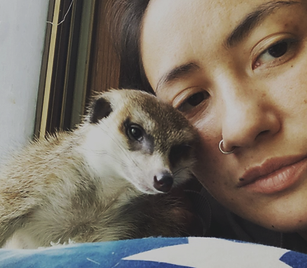
Ensconced in the lush interior of Chiba Prefecture about 90km east of Tokyo, the Animal Oasis (AnimO) is home to a growing population of exotic pets unable to find homes in Japan. Tending the flock is a job AnimO owner and operator Mina Martinez-Hoshino sees as a mission.
A UK-born Cuban-Japanese, Mina has been living in Japan for 27 years, and sports a work history as a professional singer, dancer, model, actress, stuntman, and mixed martial arts fighter. She has also appeared in several TV programs and movies.
So why change careers to save animals?
“I actually never wanted an animal sanctuary,” she admits, after moving to Chiba in 2020 with a handful of rescue animals just to get away from the city. “A few months later, COVID-19 hit, I started posting more stuff on my social media page, which seemed to get attention due to the pandemic lockdown. Pet shops and small zoos were going out of business.”
As word spread and more and more pet owners became unable to keep their own pets, discarded animals started trickling in to AnimO. Mina sensed a need for an exotic pet rescue service, and created the official nonprofit entity in May 2024. She is now formally educated and licensed to practice her craft, and holds several dog training certifications.
Living in Japan: Your Complete Guide to Bringing Pets to Japan
She currently keeps 59 animals of different species, ages, and lengths of stay. The count includes dogs, guinea pigs, chickens, and sugar gliders (seven of each), six bats, five rabbits, three cats and three tarantulas, along with two emus and two mini pigs. The bird flock includes four cockatiels, three hawks, two call ducks, two pigeons and a majestic Macaw parrot.
The term “exotic” is apt for many of the group, as they aren’t native to Japan, have adapted to live in very specific conditions, and are not meant to be kept as pets. Since it’s not possible for captive-bred animals to be returned to the wild, AnimO tries to replicate their natural habitats as much as possible so that they may enjoy a reasonably sound quality of life.
Living in Japan: Ethical Wildlife Experiences in Japan
“Some animals aren’t fit to be pets. For example, I have a meerkat that bites to the bone, and hawks need to be flown regularly by owners versed in falconry, etc.” Mina explains, adding that some of the cats are terminally ill, and a few of her dogs have aggression problems. Her emus and tegus (large, terrestrial lizards native to South America) rank as perhaps her most unorthodox pets. “Kevin Bacon” is the given name of her long-term prized pig.
While COVID-19 can be linked to the recent rise in the number of homeless pets in Japan, the nation’s “pet boom” can be traced back to 2003, when cats and dogs first began to outnumber children due to the steadily declining birth rate. Births fell for the ninth consecutive year in 2024 to the lowest level since record-keeping began in 1900.
Mina also makes it clear that AnimO is a sanctuary, not a shelter – a facility where animals can live out their lives in a protected space. AnimO is not affiliated with the larger Society for the Prevention of Cruelty to Animals (SPCA) International or the Japan Animal Welfare Society (JAWS), but works under the guidelines of the Chiba Prefecture Nature Conservation Division. With each species, her group connects with specialists from around the world through the Asia for Animals Coalition who provide specialized care information.
Living in Japan: Working to Help the Bear Population in Japan with Amelia Hiorns
As her qualifications enable her to work with native wildlife (an exclusive skill), Mina’s ideal is to build a “paradise” for each species. Her organization is entirely funded by donations and staffed by volunteers; AnimO welcomes both monetary and physical assistance as it rebuilds in its new location.
“There’s a ton of work and learning the ropes takes a while so we are prioritizing people that can live on-site with us for a minimum of two weeks,” she says. “Car owners and drivers who can help haul material are especially welcome.”
See the links below for more information, including ways to help and contribute to AnimO.
AnimO homepage: http://www.animosanctuary.org/
Patreon: https://www.patreon.com/MinasAnimalSanctuary
Facebook: https://www.facebook.com/MinasAnimalSanctuary/
Instagram: https://www.instagram.com/minas.animal.sanctuary/