You don't need perfect Japanese to put together a Japanese resume, known as a rirekisho. Employers used to expect these to be handwritten, but that is mostly a thing of the past now.
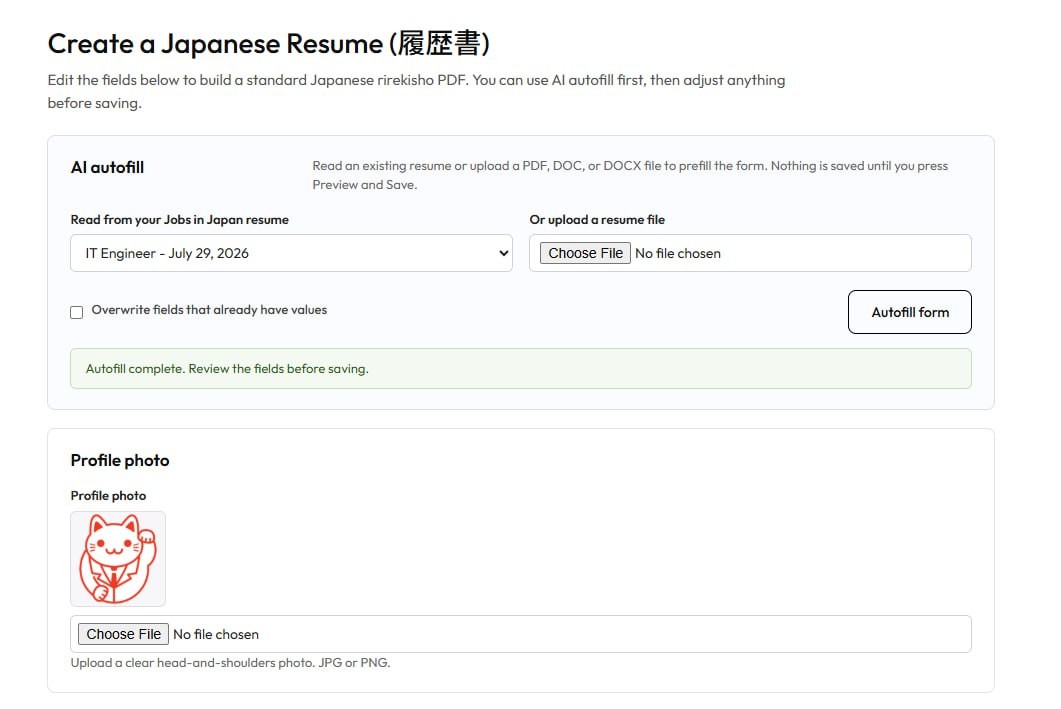
The Japanese Resume Builder on JOBS IN JAPAN makes the process much less painful. AI autofill can pull in your existing JOBS IN JAPAN resume, or you can upload a PDF or Word file instead. Then you edit any Japanese fields that need a human touch. Kanji often have multiple readings, and names do not always convert cleanly into katakana. What you get at the end is a standard Japanese rirekisho PDF.
Why you need a rirekisho
Many companies in Japan can read English resumes, especially for English-speaking roles. Even so, a Japanese resume often makes your application easier to review.
It gives employers information in a format they already recognize. It can also help Japanese HR staff, managers, and interviewers understand your background without translating everything themselves.
Japan often uses two resume documents: the rirekisho (履歴書), which covers your basic profile, education, and work history, and the shokumu keirekisho (職務経歴書), which goes deeper into your professional experience. We explain the difference in more detail in our guide to Japan's two-resume system.
Since there is no single official format for the shokumu keirekisho, it is usually easier to draft with AI. Have it focus on your duties and responsibilities instead of the punchy action verbs that English resumes love, like "spearheaded" or "leveraged."
You do not need to master every convention on a rirekisho before you apply. You just need a clean, readable Japanese version that gives the employer enough confidence to keep reading.
Convert your English resume to a rirekisho without starting from scratch
Most people do not get stuck because their Japanese is not good enough. They get stuck because they cannot even read the labels on the form. What is 志望の動機? For the record, it means "reason for applying." What should go in that box? Then there are dates, job titles, company names, duties, achievements, education, skills, certificates, and language level. It adds up fast.
You have two practical starting points:
- Read from a resume you already created in your JOBS IN JAPAN candidate account
- Upload an existing resume file
That means you are working from information you already trust instead of rebuilding your career history from scratch. You can also choose whether to overwrite fields that already have values, which is useful if you started editing but want AI to fill in whatever is left.
Too many good candidates stall their applications while waiting for the perfect Japanese resume. A clear, usable one today beats a perfect one that never gets finished.
Let AI autofill it, then fine-tune the Japanese yourself
AI translation is useful when you treat it as a first draft, not the final authority on your career.
AI autofill moves your resume information into the Japanese fields. From there, you edit each section before saving. Nothing is final until you preview and save, so you always get a chance to review it first.
Check these carefully:
- The katakana for names and addresses
- Job titles that may not translate cleanly
- Industry-specific terms
- Software, certifications, and licenses
- Teaching, management, sales, IT, customer service, or hospitality duties
- Japanese level claims, such as JLPT level or business Japanese ability
- Your Self PR and personal preferences
If your Japanese is limited, that is fine. You can still check names, dates, company names, numbers, and other obvious mistakes. If you have a Japanese-speaking friend, teacher, coworker, or recruiter you trust, ask them to glance over the final version.
The goal is not to fake perfect Japanese. It is to give the employer a document that supports your application, makes the hiring manager's job easier, and shows you understand how job applications work in Japan.
Build a standard rirekisho PDF with the details employers expect
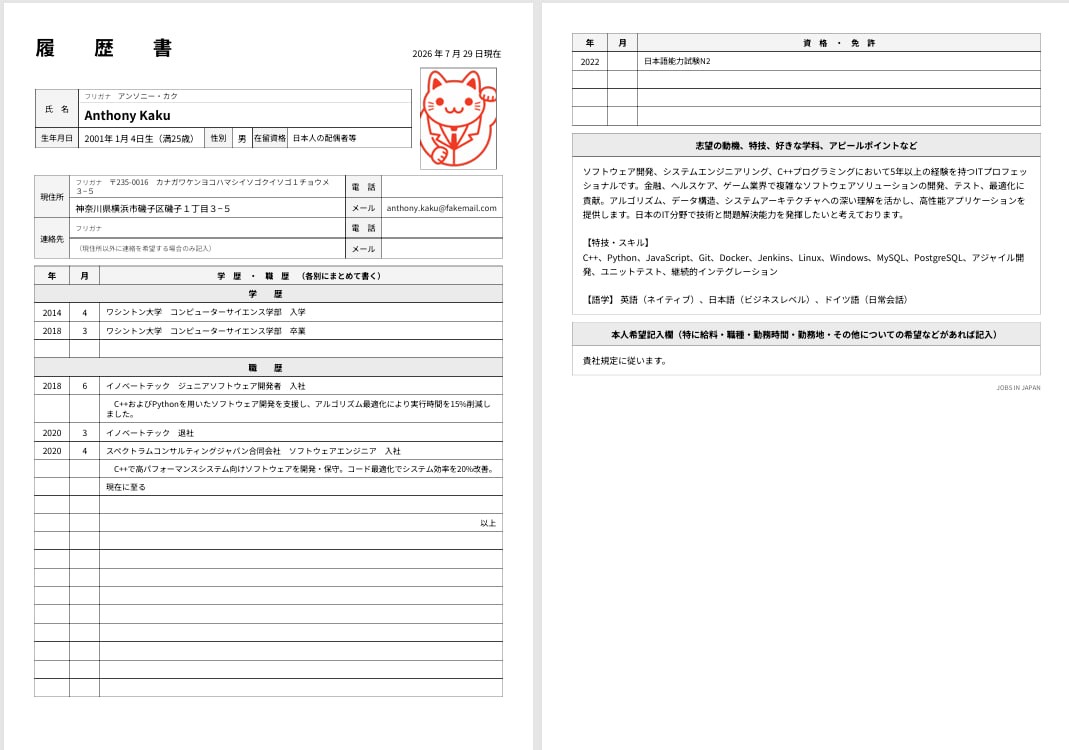
The builder is structured around the details Japanese employers expect to see in a rirekisho.
You can review and edit sections such as:
- Profile photo
- Personal details
- Education
- Work history
- Licenses and qualifications
- Languages
- Skills
- Self PR
- Personal preferences
That structure does two things. It reminds you what employers are looking for, and it keeps everything organized. That is hard to pull off when you are copying between documents or trying to format a Japanese resume by hand.
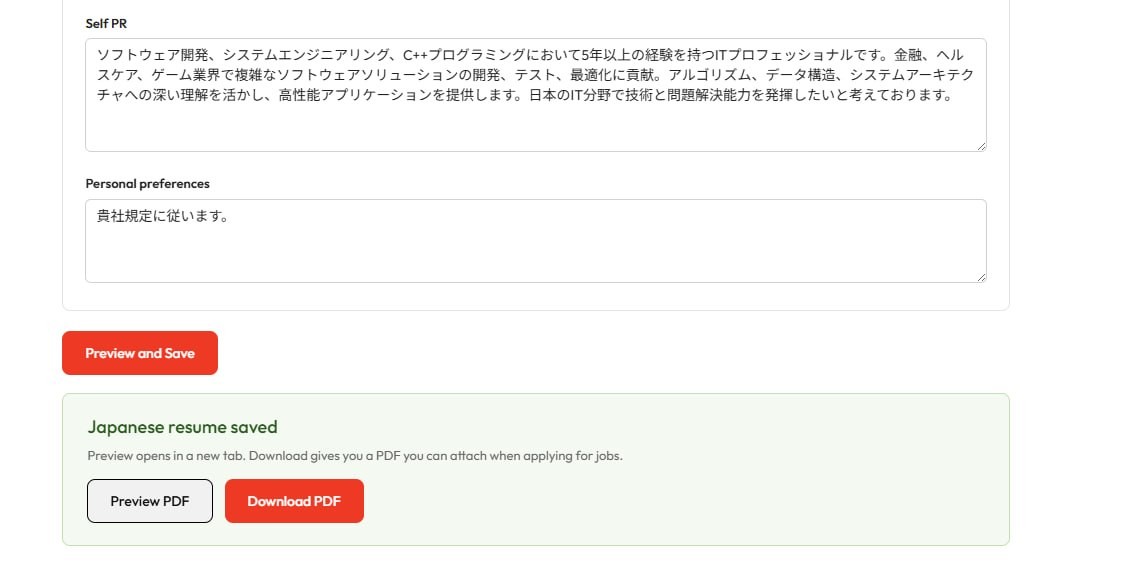
After editing, you can preview and save the resume as a PDF.
Use it when applying on JOBS IN JAPAN
You can apply with your English resume, your Japanese one, or both, depending on the job.
A Japanese resume can help when:
- The employer's HR staff mainly works in Japanese
- A Japanese manager is involved in screening
- The role requires some Japanese communication
- You want to make a stronger impression for a job you really want
- Your English resume is good, but the employer's internal process is Japanese
- They ask for it
Download it, print it, and use it outside JOBS IN JAPAN too
Once your Japanese resume is created, you can view, download, or print the PDF and use it beyond JOBS IN JAPAN: company websites, interviews, job fairs, recruiters, or those last-minute "can you send it in Japanese?" moments.
Paper still matters in Japan. Some employers prefer it, and even if you applied online, you may be asked to bring a printed copy to the interview.
Having a Japanese version ready means one less thing to scramble for.
Peter's Advice
You may also want to write a rirekisho or two by hand. Employers used to, and still do to some extent, want a hand-written one to see your penmanship as it gives insight into your personality and attention to detail. Anyway, going old-school makes an even stronger impression. Also I forget how to write certain kanji all the time, so I use my JOBS IN JAPAN version as a template to copy from instead of looking everything up on my phone.
A Japanese resume gives you more options
Even if an employer does not ask for a rirekisho up front, it is worth having one ready. It can make a strong impression when you are sitting across from a Japanese hiring manager.
Use the JOBS IN JAPAN Japanese Resume Builder to turn your existing English resume into a standard rirekisho PDF, with AI autofill and translation support included. You can use it online or print it for interviews.
We wish you success with your job search.